The fastest way to overpay for a diamond is to buy the certificate instead of the stone. Plenty of shoppers chase the highest letters on the grading report – D color, flawless clarity – and end up spending hundreds or thousands of dollars on differences nobody will ever see on a finger.
This guide is about the opposite approach. The best diamond grade for value is the combination that gives you the most visible beauty for the least sensible spend, and that almost never means maxing out every grade. It means knowing which of the 4Cs your eye actually responds to, and which ones are mostly there to justify a markup.
If you only remember one thing, make it this: learn to read what your eye sees, then let the report confirm it. That’s how you choose a diamond grade without funding someone else’s marketing budget.
What “best value” actually means in diamond grading
Value here is simple to define: visual impact per dollar. Two diamonds can carry very different grades, cost very different amounts, and look identical on your hand under normal light. When that happens, the cheaper one is the better value, full stop.
The reason this matters is that diamond pricing climbs steeply at the top of each grade scale, while the visible payoff flattens out. Moving from a near-colorless stone to a top colorless one, or from an eye-clean stone to a flawless one, often costs a meaningful premium for a difference you’d need a loupe and a trained eye to spot.
There’s a useful distinction to keep in your head as you shop: certificate perfection versus what your eye sees. A grading report describes a stone under magnification, in controlled lighting, compared against master stones. Your everyday experience of the diamond happens at arm’s length, in mixed light, on a moving hand. Those are not the same viewing conditions, and the gap between them is exactly where value lives.
None of this means grades don’t matter. It means they matter unevenly. Some grades change how a diamond looks the instant you glance at it, and some only change the number on the invoice.
The 4Cs ranked by real-world impact
Most 4Cs guides treat cut, clarity, color, and carat as four equal levers. They aren’t. Ranked by how much each one changes what you actually see, the order that matters most for value is cut, then clarity, then color, then carat. Here’s how to spend on each.
Cut – your first non-negotiable
Cut is the grade that decides whether a diamond sparkles or sits there looking flat, and it’s the one place we’d tell you never to compromise. According to GIA, a diamond’s cut governs its brightness (the white light it returns), its fire (the flashes of color), and its scintillation (the sparkle as it moves). A poorly cut stone leaks light out the bottom and sides instead of bouncing it back to your eye, and no amount of high color or clarity rescues that.
The practical floor is straightforward. On GIA’s scale, that means Excellent. Some sellers and the older AGS system use the word “Ideal” for their top tier, so if you see best cut grade diamond listings labeled Ideal, that’s the same neighborhood – aim there. For round brilliants, this is the easiest grade to standardize, because the round cut has well-defined proportions that labs grade directly.
Polish and symmetry sit just underneath cut, and they’re worth understanding without overstating. Polish describes the surface finish; symmetry describes how precisely the facets line up. Both contribute to how cleanly light travels through the stone, and you generally want them strong rather than mediocre. That said, they’re a refinement on top of the core cut architecture, not a substitute for it. Lock the top cut grade first, keep polish and symmetry in the Very Good to Excellent range, and you’ve handled the most important spending decision in the whole process.
Clarity – buy eye-clean, not ego-clean
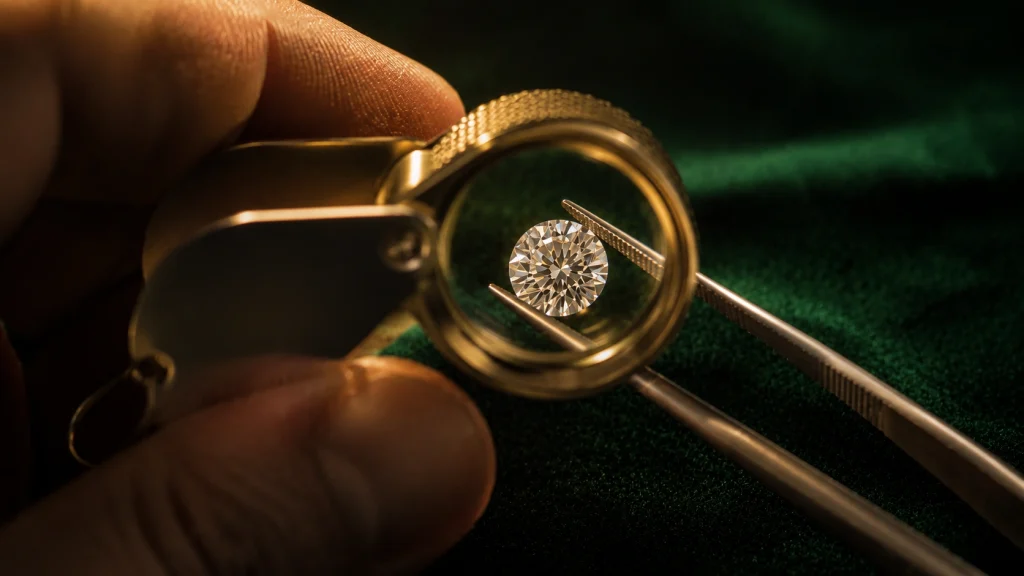
Clarity measures the tiny internal features (inclusions) and surface features (blemishes) in a stone, graded from Flawless down through VVS, VS, SI, and I on the GIA scale. The trap is assuming higher is always worth paying for. For value, the target isn’t flawless – it’s eye-clean, meaning no inclusions visible to the naked eye at normal viewing distance, roughly arm’s length.
For the best diamond clarity for eye clean, most buyers do well in the VS2 to SI1 range, with selection care. A VS2 stone is very often eye-clean. Many SI1 stones are too, depending on where their inclusions sit and how big they are. The catch is that the grade alone doesn’t guarantee it, because a grade is an overall summary, not a map of where each inclusion lands.
That’s why inclusion location matters as much as the grade letter. An inclusion tucked near the edge, where a setting’s prongs might cover it, is very different from one sitting dead center under the table where light draws your eye. Two stones can both be graded SI1 and look completely different to the naked eye. The move here is to look at the actual stone – high-resolution photos or a video – rather than buying a grade sight unseen. Confirm eye-clean for the specific diamond, and you can comfortably skip the premium that VVS and Flawless command.
Color – where “good enough” looks the same to most people
Diamond color is graded D through Z, where D is completely colorless and the scale moves toward faint yellow or brown as you go down. D, E, and F are colorless; G through J are near-colorless. The best diamond color grade for value almost always lives in that near-colorless band rather than at the very top.
Here’s the thing about color: the differences between adjacent grades are subtle, and they get harder to see once a stone is mounted and viewed face-up. Labs grade color face-down against master stones precisely because that’s the hardest viewing angle – which is not how anyone looks at a ring in real life. Face-up, on a hand, in mixed lighting, a G or H frequently looks identical to a D to an untrained eye. For most buyers, F to H is the sweet spot, with H to I still looking great in many settings.
Your metal choice shifts this. In white gold or platinum, very warm stones can read slightly tinted against the bright white metal, so leaning a touch higher (F to G) is reasonable. In yellow or rose gold, the warm metal masks faint color entirely, so you can comfortably drop to H, I, or even J and let the setting do the work. Spending up to D color “just to be safe” in a yellow-gold ring is one of the cleaner examples of paying for something you’ll never see.
Further reading: GIA vs IGI Diamond Certificates: The No-Bullshit Comparison
Carat – size only after the quality thresholds are secured
Carat is weight, not size as your eye perceives it, and it’s the grade buyers over-index on the most. It’s also the easiest one to understand, which is part of why it gets outsized attention: a bigger number feels like more, and price climbs sharply at the round milestones like 1.00ct and 2.00ct.
The value move is to treat carat as the variable you adjust last. Once you’ve locked a top cut grade, confirmed eye-clean clarity, and chosen a near-colorless grade that suits your metal, whatever budget remains decides your size. A well-cut, eye-clean, near-colorless stone at a slightly smaller carat will out-sparkle a larger stone that compromised on cut to hit a size target, every time.
A couple of practical levers help your budget here. Buying just under a milestone weight (say 0.90ct instead of 1.00ct, or 1.90ct instead of 2.00ct) often saves a noticeable amount for a diameter difference you can barely measure. And because cut quality affects how large a stone looks face-up, a top-cut diamond can wear bigger than its weight suggests. Size matters, but it’s the reward for getting the other three right, not the place to start.
Lab-grown diamond vs natural diamond for grading value
At equal specifications, you judge a lab-grown diamond and a mined diamond exactly the same way: cut first, then eye-clean clarity, then color, then size. A lab-grown diamond is the same molecule as a mined one – the same carbon lattice, the same hardness, the same refractive index – so light behaves identically. The ideal diamond grade lab grown buyers should target is the same set of thresholds we’ve already covered.
Where the two genuinely differ is the market, not the physics. At a given budget, lab-grown inventory tends to make higher color and clarity grades far more reachable than comparable mined-diamond inventory at the same spend. That’s a pricing and availability reality, and it’s worth stating plainly: the value framework in this guide is the same, but lab-grown often lets you sit comfortably in the strong end of each range instead of stretching for it.
One honest caveat on paperwork. Not every grading report is built the same way, and grading practices and report formats have shifted over the years. IGI grades the large majority of lab-grown diamonds on the market, and it’s the lab we certify our own stones with for 0.5ct and up. Different labs can apply slightly different standards, so don’t assume a color or clarity letter from one lab is interchangeable with the same letter from another. Read the actual report, and compare stones graded by the same lab whenever you can. If you want a deeper walkthrough, our guide on how to read a diamond certificate covers what each line actually means.
Further reading: Lab diamond vs natural diamond: what’s actually different?
A brief note on moissanite for value-focused buyers
If your priority is maximum beauty for minimum spend, moissanite deserves a serious look. It’s silicon carbide, not carbon, so it isn’t a diamond – it’s its own stone, first identified in a meteor crater by Henri Moissan in 1893 and now grown in labs. On hardness it’s nearly diamond’s equal at 9.25 on the Mohs scale versus diamond’s 10, which means it holds up well to daily wear.
Optically, moissanite has a different character. Its dispersion (fire) is about 0.104 against diamond’s 0.044, so it throws noticeably more rainbow flash, and its refractive index of roughly 2.65 to 2.69 sits above diamond’s 2.42. In bright light, that extra fire is the giveaway some people love and others want to avoid. On lab diamond vs moissanite quality, neither is “lower quality” – they optimize for different looks, and both are genuinely durable, certified stones.
The reason it matters for this guide is price. Moissanite typically runs around 5 to 10% the cost of an equivalent-spec lab-grown diamond, which is why we consider it the strongest value in fine jewelry. The honest version of the trade-off is this: choose lab-grown diamond when you specifically want diamond’s white-brilliance look or the fact that it’s chemically a diamond matters to you, and choose moissanite when you want the most visual sparkle per dollar and don’t mind a little extra fire. We cover the full breakdown in our lab diamond vs moissanite comparison.
Further reading: Diamond vs Moissanite: The Honest Comparison in 2026
Best-value grade combinations by budget mindset
There’s no single “best” spec sheet, because the right answer depends on what you’re optimizing for. Three common mindsets cover most buyers, and each keeps cut at the top while flexing the other grades.
If your priority is maximum sparkle at a fixed budget, hold cut at Excellent or Ideal, sit at F to G color, choose a confirmed eye-clean VS2, and let carat flex downward to fund the quality. This profile reads as bright and clean and punches above its size.
If you want the largest stone that still looks clean, keep the same top cut grade, step color down to H (or lower in yellow or rose gold), target an eye-clean SI1 you’ve inspected on video, and put the saved budget into carat. You get visible size without sacrificing the sparkle that cut provides.
If you want a safe middle path, go Excellent or Ideal cut, G color, a VS2 confirmed eye-clean, and a carat weight that lands just under the next round milestone. This balanced default is hard to get wrong and is what we’d suggest if you’re unsure how to choose a diamond grade and just want a sensible starting point.
Common overpay traps, and how to avoid them
The most expensive habit in diamond shopping is paying for VVS or Flawless clarity when a properly selected, eye-clean VS or SI stone looks identical on the hand. Past your wrist, the inclusions in a well-chosen eye-clean stone simply aren’t visible, so the premium buys you a number on paper and nothing you can see.
The second trap is defaulting to D color out of caution. Unless you’re setting a step-cut stone in bright white metal and you’re genuinely sensitive to faint warmth, near-colorless grades in the F to H range deliver the same face-up appearance for less. In warm metals, the saving is even cleaner because the setting hides any trace of color.
The third trap is the one that actually hurts the result: compromising cut to afford a bigger carat number. A larger stone with a mediocre cut looks dull and lifeless next to a slightly smaller stone cut to return light properly. Cut is what people read as “sparkle,” and trading it away for size is the rare diamond decision that makes the stone both more expensive and less beautiful than the alternative.
A 7-point checklist before you buy
Run through these seven points before you commit, in this order, and you’ll avoid almost every common mistake.
- Cut minimum: confirm the top cut grade (Excellent or Ideal), with polish and symmetry at Very Good or better.
- Eye-clean confirmation: verify the specific stone is eye-clean, not just that the grade is usually clean.
- Face-up video review: watch a 360-degree video of the actual diamond, not a stock image.
- Color in context: check the color grade against your real metal choice (white versus yellow or rose).
- Lab consistency: note which lab graded it, and compare stones graded by the same lab.
- Return and review terms: confirm you can inspect and return the stone or finished piece if it isn’t right.
- Price sanity check: compare the total spec against equivalent stones so you know the price is fair.
Frequently asked questions
What’s the single most important of the 4Cs for value?
Cut. It’s the grade that controls brightness, fire, and scintillation, which is what people actually perceive as sparkle. A top cut grade makes a stone look alive, and it’s the one C we’d tell you never to compromise to save money or gain size.
What clarity grade is best for an eye-clean diamond?
For most buyers, VS2 to SI1 hits the sweet spot. VS2 is very often eye-clean, and many SI1 stones are too, but the grade alone doesn’t guarantee it. Always check the specific stone, because inclusion size and location matter as much as the grade letter.
Is D color worth paying for?
Usually not, for value. D, E, and F are colorless, but face-up on a hand, near-colorless grades like F through H typically look identical to most people. In yellow or rose gold, you can drop even lower, because the warm metal hides faint color entirely.
Do lab-grown diamonds use the same grading scale?
They’re graded on the same 4Cs framework, with IGI grading the large majority of lab-grown stones. Standards and report formats can vary between labs, so read the actual report and compare stones graded by the same lab rather than assuming identical letters mean identical results.
Is moissanite better value than a lab-grown diamond?
On price, clearly – it typically costs around 5 to 10% of an equivalent lab-grown diamond. Whether it’s “better” for you depends on the look you want: moissanite throws more fire, while lab-grown diamond gives the white-brilliance appearance most people associate with diamonds. Both are durable and certified.
Does cut grade matter the same way on fancy shapes?
Cut still matters most, but the standardized cut grade applies cleanly to round brilliants. Fancy shapes like oval, cushion, and emerald are judged more on proportions and how the individual stone performs, so lean harder on the video and look for even, lively light return rather than a single grade.
How big a diamond can I get without it looking cheap?
Size only looks cheap when cut is sacrificed to get it. A well-cut, eye-clean, near-colorless stone at a modest carat weight looks far more impressive than a larger stone with a weak cut. Lock cut, clarity, and color first, then buy the largest carat your remaining budget allows.
Get a spec recommendation built around your budget
The right diamond grade for value is the one that fits your budget, your metal, and the look you’re after – not a fixed formula. Send us your budget and the look you want, and we’ll come back with a transparent spec recommendation, including the trade-offs, so you can see exactly where every dollar is going. Request a quote and we’ll talk you through cut, clarity, color, and carat for your specific piece.