Most people start ring shopping by asking the wrong question. They ask “how much should I spend?” as if there’s a right answer waiting somewhere, a number that proves they did it properly.
There isn’t. The number you’ve probably heard – one month’s salary, two, three – didn’t come from anywhere wise. It came from advertising. And once you see that, the whole question changes shape.
The better question is simple: what do you actually want the ring to look like, and what does that cost to make? That’s a problem you can solve. This article walks through where the spending myth came from, what should really set your budget, and what specific budgets buy in the real world.
We’re not anti-romance here. We’re anti-manipulation. Those are very different things.
Where the “how much should you spend?” rule came from
The idea that a ring should cost a fixed slice of your income feels like old wisdom. It isn’t old, and it isn’t wisdom.
In 1947, the ad agency N.W. Ayer wrote the line “A Diamond Is Forever” for De Beers. It’s one of the most effective marketing campaigns ever written, and it did something clever: it tied a manufactured product to an emotion that has no price ceiling. If a diamond represents how much you love someone, then spending less starts to feel like loving less. That’s the trick, and it’s a good one.
The salary rule was the follow-through. De Beers seeded the notion that a man should spend around a month’s salary on an engagement ring, a figure that crept up to two months and later three as the decades passed. Notice that the “correct” amount kept rising. A genuine financial guideline doesn’t double because a marketing department wants it to.
So when someone tells you the proper spend is three months’ salary, what they’re really repeating is a sales target from the middle of the last century. It survived because it’s sticky and because the people who profit from it kept it alive. It has nothing to do with your finances, your partner, or the ring itself.
Knowing this doesn’t make the tradition meaningless. Plenty of people love the ritual of buying a ring, and that’s good. It just means the number is yours to set, not theirs.
Further reading: De Beers: The Company That Invented Diamond Scarcity
What should actually determine your ring budget
If salary folklore is out, what’s left is more useful anyway. A ring budget should come from a handful of real inputs, and none of them is “what other people spent.”
Start with your financial reality. The right number is one you can pay without flinching, without debt you’ll resent, and without the purchase casting a shadow over the first year of something that’s supposed to feel good. A ring you’re quietly anxious about is a worse ring, regardless of the carat weight.
Then consider your partner’s taste, which matters far more than the price. Some people want presence and size. Some want something fine and understated they’ll never take off. Buying a large, showy ring for someone who wanted something delicate is overspending, even if the receipt looks impressive.
After that, it’s a question of priorities, and there are really only a few that move the needle:
- Size versus sparkle versus prestige – do you care most about how big it looks, how much it throws light, or what the stone “is” on paper?
- Stone type – moissanite and lab-grown diamond behave differently and cost very differently.
- Metal – gold purity and color change both the look and the price.
Finally, think about how the ring lives on a hand. This is an object someone wears every day, in the shower, doing dishes, carrying groceries. Durability and practicality are part of the value, not an afterthought. A budget built from these inputs gives you a ring that fits the person and the life. A budget built from a salary multiple gives you a ring that fits an ad campaign.
What different ring budgets can realistically get you
This is where most articles go vague and ours won’t. Below are real configurations and what they cost to make at WunderJewelry, so you can map a number to an actual ring instead of an “average.” Prices reflect made-to-order solitaires in solid gold, never plated, with the stone set and finished.
Read these as anchors. They show how stone type, carat, and gold purity each push the price, so you can see exactly where your money goes.
Around $650
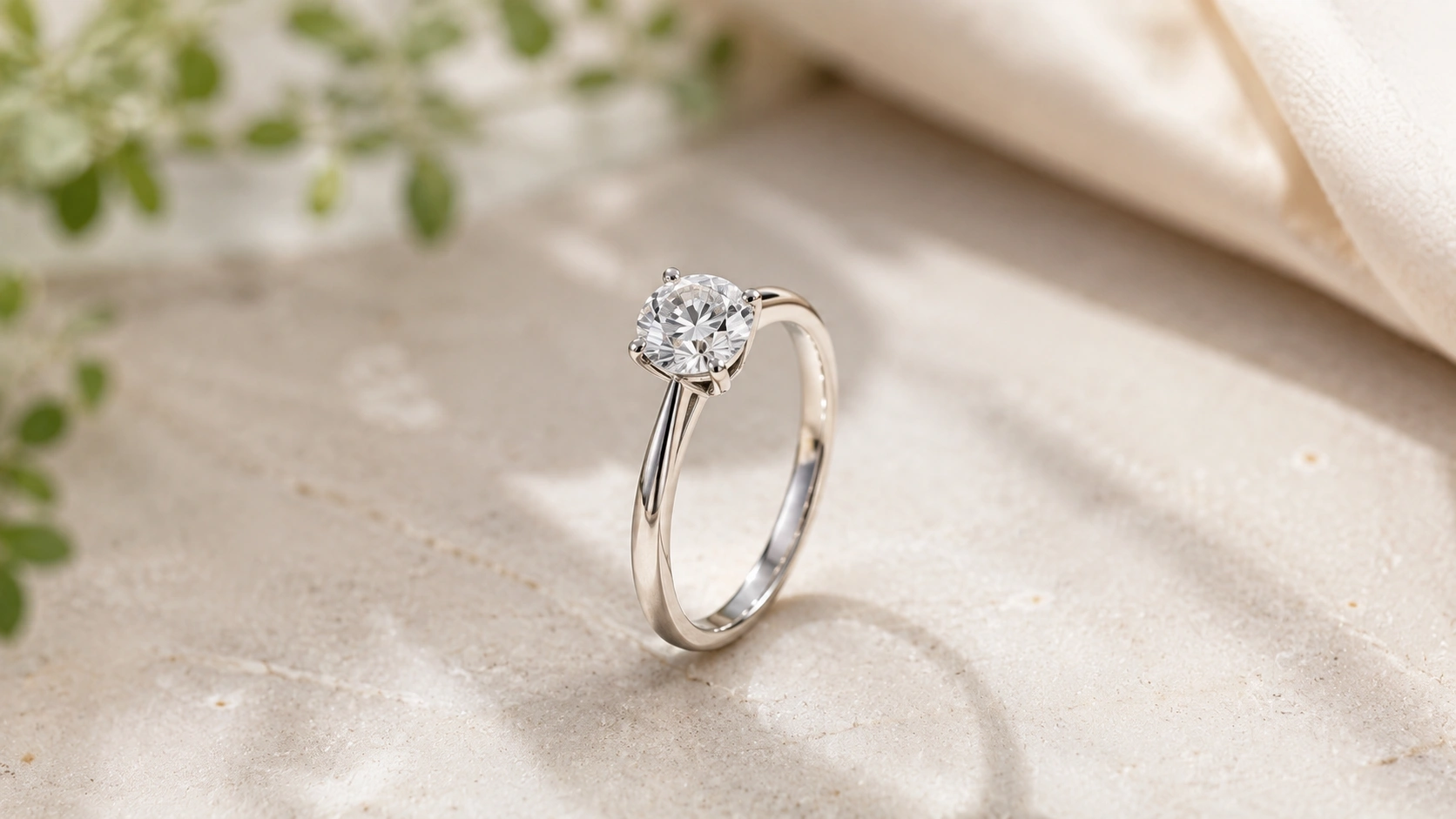
A 1ct moissanite solitaire in 14k white gold sits near $650. For most people, this is the quiet shock of ring shopping: a full carat, real solid gold, a stone with more fire than a diamond, for the price of a decent phone.
Moissanite at this size reads as a classic solitaire across a room. Nobody glances at a hand and runs a gemological test. If your priority is a beautiful, durable, everyday ring without a four-figure outlay, this is the value floor that’s hard to argue with.
Around $800
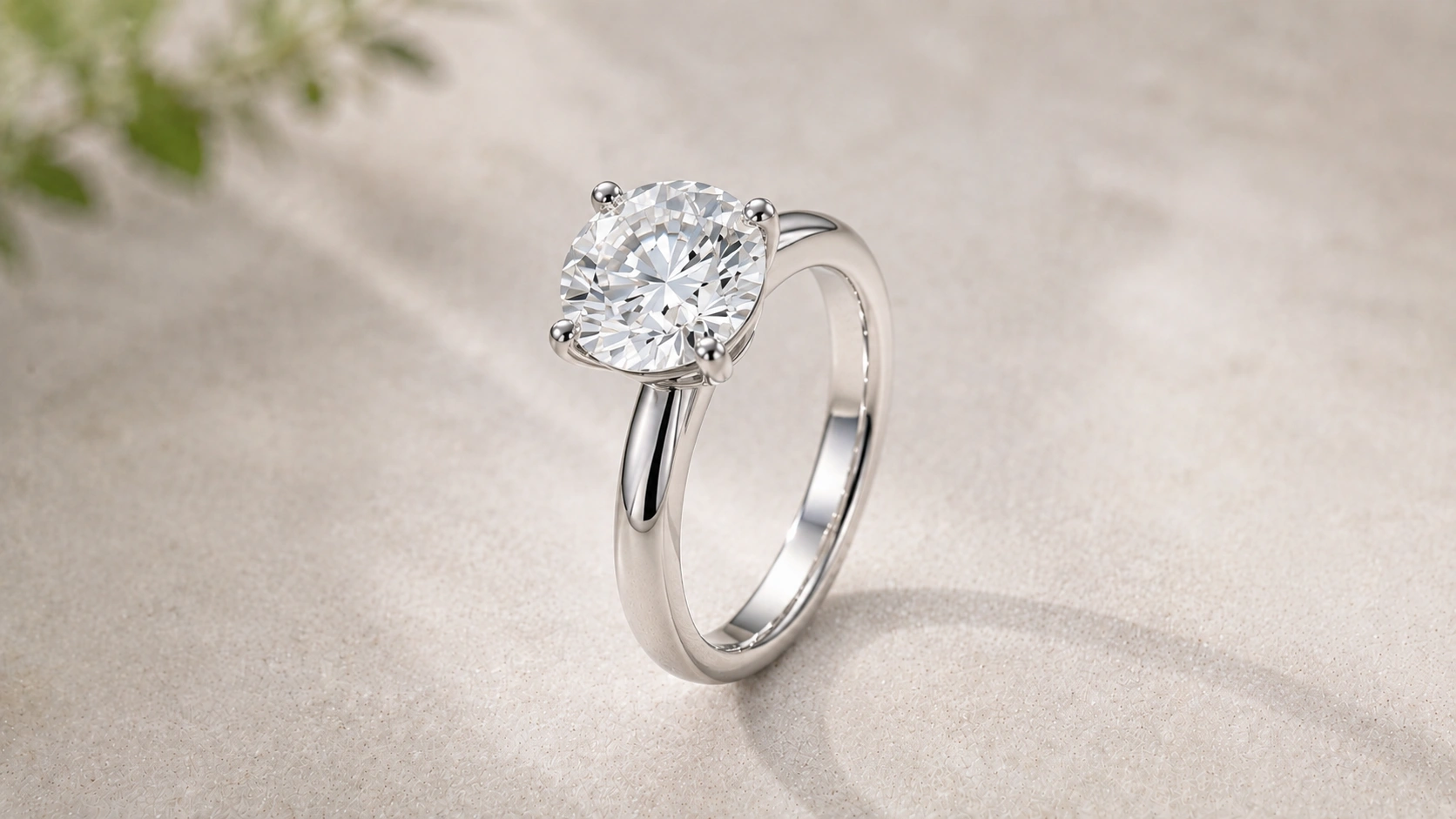
Step up to a 2ct moissanite solitaire in 14k white gold and you’re around $800. That extra $150 roughly doubles the visual size of the center stone.
This is one of the best size-per-dollar moves in the entire category. If presence on the hand is what your partner cares about, moissanite is how you get there affordably, because the cost of going bigger in moissanite is gentle compared to diamond. Two carats for a few hundred dollars over the one-carat version is the kind of math the salary rule actively discourages you from noticing.
Around $1,100
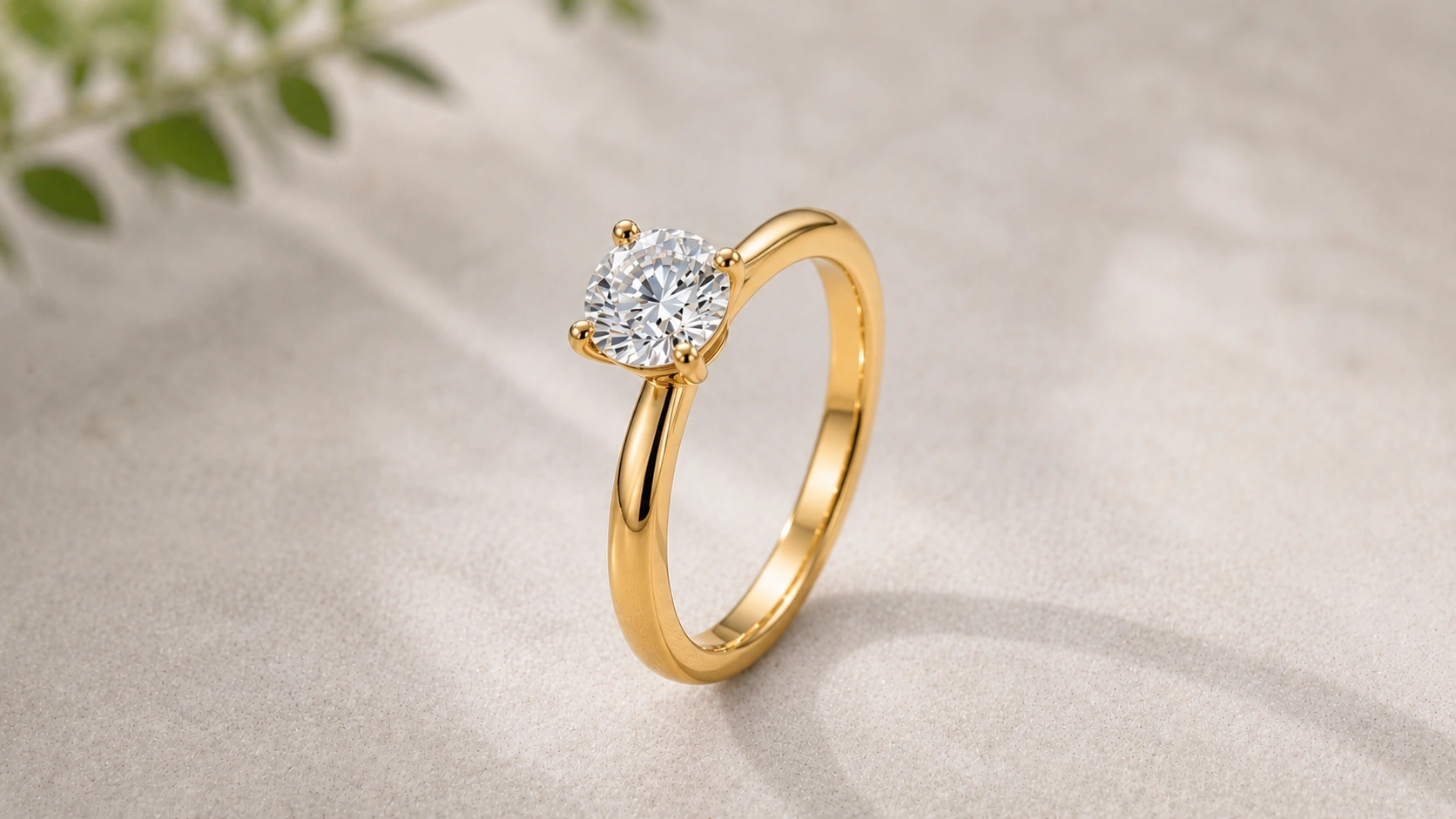
A 1ct lab-grown diamond solitaire in 14k gold runs around $1,100. Here you’re paying for the stone to be diamond – the same carbon molecule as a mined diamond, the same hardness, the same brilliance pattern – grown in a lab and certified by IGI rather than dug out of the ground.
If “it’s a diamond” matters to your partner, this is the honest, sane way to get one. You’re paying a real premium over moissanite for that specific stone, but a fraction of what an equivalent mined diamond would cost. For many buyers this is the sweet spot: genuine diamond, full carat, comfortably under fifteen hundred.
Around $1,400
The same 1ct lab-grown diamond in 18k white gold instead of 14k lands around $1,400. The difference is the metal, not the stone.
18k gold has a higher gold content, which gives white gold a slightly warmer base and a denser, more substantial feel. It’s softer than 14k and a touch more prone to scratching, which is the honest trade-off. Whether the upgrade is worth roughly $300 depends entirely on whether you or your partner care about gold purity. Many people genuinely can’t tell 14k from 18k on a finished white-gold ring, because both get rhodium-plated for that bright white finish anyway.
Around $2,000
At roughly $2,000 you get a 2ct lab-grown diamond solitaire in 18k white gold. This is a serious ring: two carats of certified lab diamond, the higher gold content, real presence on the hand.
It’s also a useful number to sit with, because two thousand dollars for a 2ct diamond ring is wildly below what the traditional retail version of this ring would cost. Same materials, same craftsmanship, a very different price, because the markup model is different. If your instinct was to spend “three months’ salary,” this is roughly the ring that instinct was trying to talk you out of buying for less.
Moissanite vs lab-grown diamond: how that choice changes your budget
The single biggest lever on your budget isn’t carat weight or gold purity. It’s which stone you choose. Get this decision right and the rest of the budget falls into place.
Moissanite is the smartest value move in most cases. It’s silicon carbide, first discovered in meteor craters in 1893, now grown in labs. It’s nearly as hard as diamond (9.25 versus 10 on the Mohs scale), it actually throws more rainbow fire than diamond does, and it costs a small fraction of an equivalent lab diamond. If you want maximum size and sparkle per dollar, or you simply don’t want to pour money into a stone’s paperwork, moissanite wins and it isn’t close.
Lab-grown diamond makes more sense when the stone being a diamond is part of the point. Some people want diamond’s specific look – its particular balance of white brilliance over colored fire – and some people just want to know the thing on their hand is, by every chemical and optical measure, a diamond. That’s a real preference, and a lab diamond honors it without the mined-diamond price or the ethical baggage.
The thing to reject is the framing that moissanite is a “compromise” and diamond is the “real” choice. That hierarchy is marketing residue, the same machinery that built the salary rule. Choose based on what you want the ring to be, not on which stone the industry assigned more status.
Further reading: Diamond vs Moissanite: The Honest Comparison in 2026
Where spending more actually matters
More money does buy a better ring in specific, visible ways. It’s worth knowing which upgrades you can see, because those are the ones worth paying for.
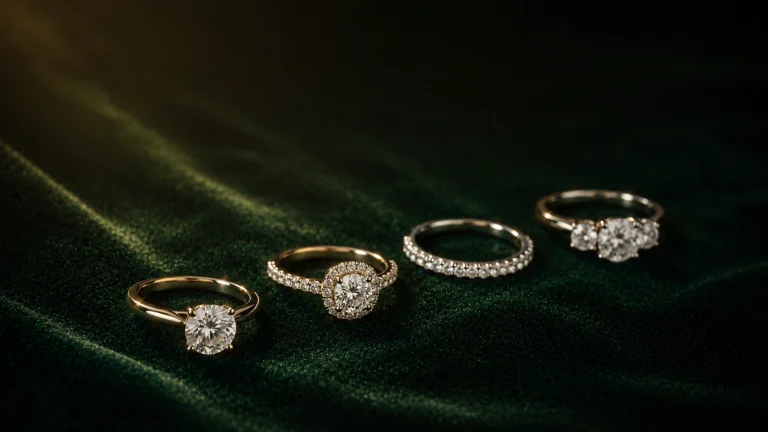
A larger center stone is the most obvious one. Going from one to two carats genuinely changes the ring on the hand, and if size is the priority, that’s money doing real work. Higher gold content shifts the color and heft of the metal, which some people notice and value. More complex settings – a halo of small stones around the center, pavé along the band, a three-stone design – add material, labor, and visual richness that you can actually see and feel.
Spending more on these things is rational, because each one changes the object you end up wearing. You’re buying a different ring, not a different story about the ring. That’s the test: if the extra money alters what the ring looks like on a hand, it’s probably worth considering.
Where spending more often matters less than people think
Just as often, more money buys nothing you can see. These are the upgrades to be skeptical of, because they cost real dollars and change little.
The biggest one is paying to satisfy a benchmark. Stretching to hit a salary multiple, or a number you think you’re “supposed” to reach, adds zero beauty to the ring and a fair amount of stress to your finances. You’re buying a feeling of having done it right, and that feeling was manufactured to sell stones.
Then there are the invisible spec upgrades. Pushing a diamond from a near-colorless grade to the absolute top of the color scale, or from an eye-clean clarity to flawless, can add a lot to the price while changing nothing a normal person sees on a finger in normal light. The same goes for chasing a mined diamond over a lab diamond, where you can pay many times more for a stone that’s physically identical. The ring on the hand looks the same. The only difference lives on the certificate and in the price.
The pattern is consistent: money spent on what the ring is shows up; money spent on what the ring is “supposed” to be does not.
How to set a ring budget without getting manipulated
Here’s the whole method, working in the opposite direction from how the industry trains you. Instead of starting with a number and forcing a ring to fit it, start with the ring and let the number follow.
- Start with your financial comfort. Decide on a range you can pay without strain. This is the only place your income belongs in the decision, and it’s a ceiling, not a target.
- Decide what look matters most. Talk to your partner, or pay close attention to what they already wear. Size, sparkle, a specific shape, a metal color – figure out the one or two things they actually care about.
- Choose stone type and metal on purpose. Moissanite or lab diamond, 14k or 18k, white or yellow or rose. Each choice has a known cost, so you’re making trade-offs with your eyes open.
- Work backward from the result. Build the ring that delivers the look your partner wants, at the spec you chose, within the range you set. The price is an output of those decisions, not an input you were handed.
Do it this way and you can’t really be manipulated, because the salary number never enters the equation. You end up with a ring chosen for a person and a life, at a price you decided on, which is the entire point.
Frequently asked questions
Do I need to spend three months’ salary on a ring?
No. The three-months-salary guideline came from De Beers marketing, not financial advice, and the “right” figure conveniently rose over the decades as the industry pushed it. Spend what fits your finances and the ring you want, and ignore the multiple entirely.
Is $1,000 enough for a good ring?
Easily. Around $650 buys a 1ct moissanite solitaire in solid 14k white gold, and roughly $800 gets you a 2ct version. If you want an actual diamond, a 1ct lab-grown diamond solitaire in 14k sits near $1,100. A thousand dollars is a comfortable budget for a ring that looks excellent on the hand.
Is moissanite a compromise?
Only if you’ve absorbed the marketing that says so. Moissanite is nearly as hard as diamond, throws more fire, is fully certified, and costs a fraction of the price. Calling it a compromise is a status judgment, not a quality one. For most buyers it’s the smartest value in fine jewelry.
How much more should I spend for 18k versus 14k?
In our examples, moving the same 1ct lab diamond solitaire from 14k to 18k white gold adds roughly $300. 18k has a higher gold content and feels a little more substantial, but it’s also softer. On a rhodium-plated white-gold ring, many people can’t see the difference, so treat it as a preference rather than an upgrade.
Is a lab-grown diamond worth the premium over moissanite?
It’s worth it if the stone being a diamond matters to you or your partner – the look, or simply knowing it’s a diamond by every measurable standard. If you mainly want size, sparkle, and value, moissanite gives you more ring for the money. Neither is the “correct” answer; it depends on which you actually care about.
Setting your number
A ring budget isn’t a test you pass by spending enough. It’s a design decision, and you’re allowed to make it on your own terms.
Decide what you want the ring to look like, choose the stone and metal that get you there, and land on a number that feels good to pay. That’s the no-bullshit answer: spend on what changes the ring, skip what only changes the story, and let a price you’re comfortable with be exactly enough.
If you already have a look in mind, send it to us with your budget and we’ll come back with a couple of honest spec options – stone, carat, and metal – that get you there. You can request a quote and see real numbers before you commit to anything. If you’re still weighing your center stone, our lab diamond vs moissanite comparison lays out exactly how the two differ.
Further reading: Lab diamond vs natural diamond: what’s actually different?