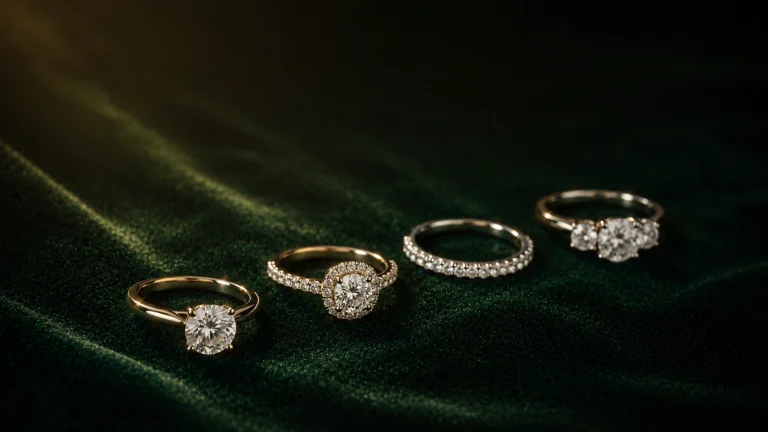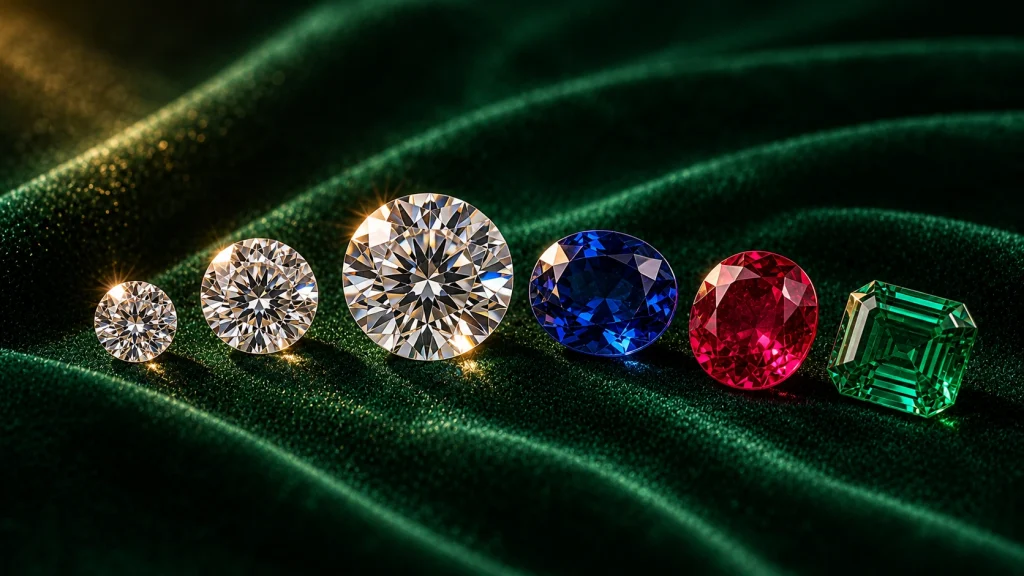
Most people shopping for a center stone have never held a 1ct diamond in natural light. They’ve seen carat numbers in ads, ring photos shot with a macro lens, and friends’ rings glimpsed across a dinner table. None of that gives you a reliable sense of scale, which is exactly why first-time buyers so often over- or undershoot.
This guide fixes that. We’ll translate carat weight into the millimeter dimensions your eye reads first, show how cut shape changes the apparent size at the same weight, and explain why a 1ct sapphire and a 1ct diamond don’t look the same size at all. Then we’ll get practical about what works for engagement rings, earrings, pendants, and bracelets.
We make custom pieces in lab-grown diamonds, moissanite, and lab-grown colored stones, so we quote these sizes every day. The advice here is the same thing we’d tell you over email before you approve a render: chase the look and the wearability, and let the carat number follow.
First principle: carat is weight, millimeters are what you see
A carat is a unit of weight equal to 0.2 grams. It says nothing directly about how wide a stone is when you look down at it, which is the thing that actually registers as “big” or “small.” Two stones can share a carat weight and still read as different sizes, because weight can hide in a stone’s depth where the eye never sees it.
The number that matters for appearance is the face-up measurement in millimeters – the width across the top of the stone as it sits in a setting. For round stones, that’s a single diameter. For fancy shapes, it’s a length and a width.
Here’s a rough millimeter anchor for round brilliant diamonds, the most common reference point. Treat these as close approximations, since exact dimensions shift a little with each stone’s proportions.
| Round diamond | Approx. face-up diameter |
|---|---|
| 0.5ct | about 5.2 mm |
| 1.0ct | about 6.5 mm |
| 1.5ct | about 7.4 mm |
| 2.0ct | about 8.2 mm |
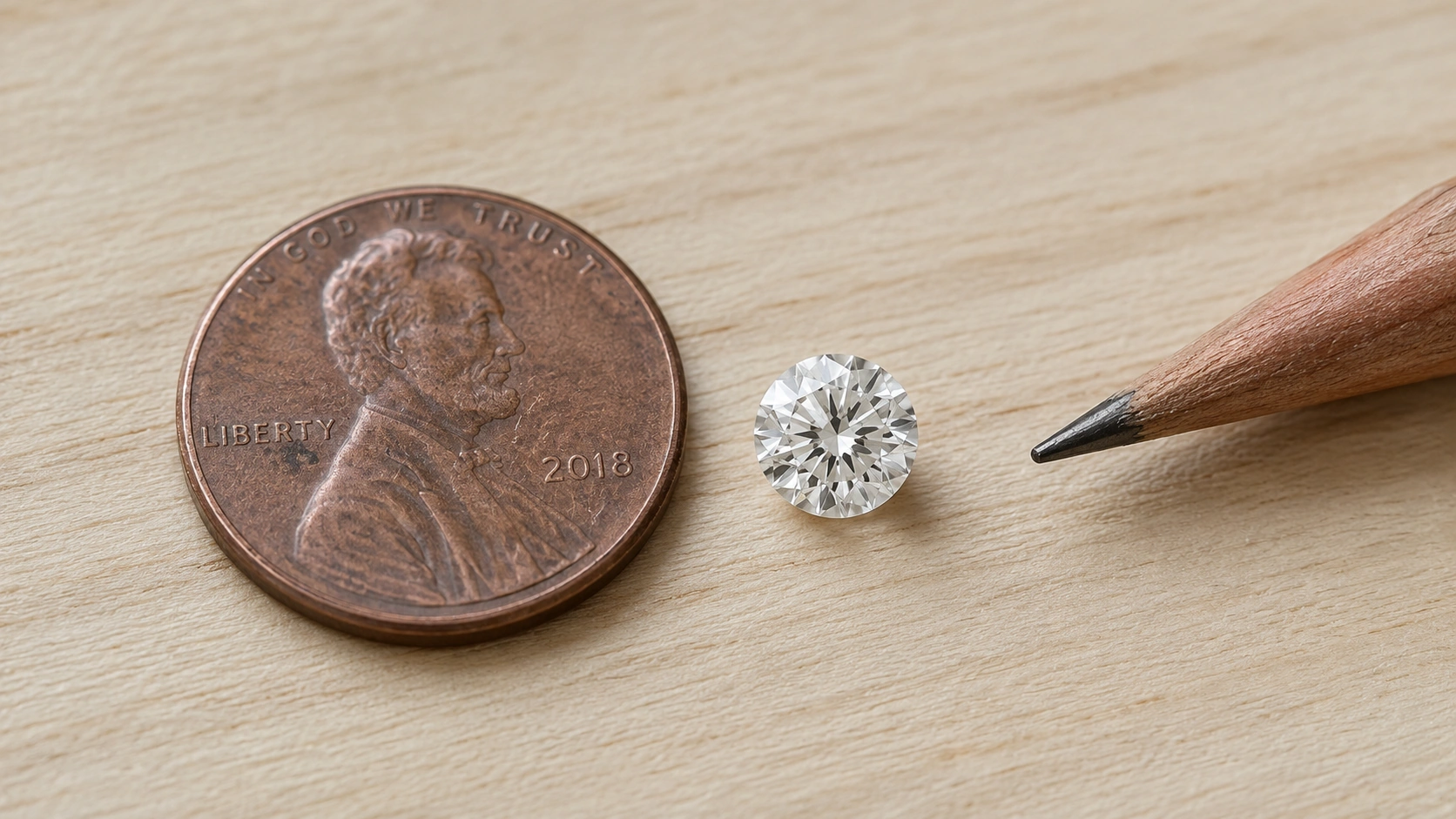
Notice that doubling the carat weight does not double the width. Going from 1ct to 2ct adds weight in every direction, including depth, so the face-up diameter grows by only about 25 to 30 percent. That single fact explains a lot of buyer disappointment: people expect a 2ct stone to look twice as wide as a 1ct, and it doesn’t.
Further reading: Best diamond grade for value: how to maximize beauty per dollar
0.5 vs 1 vs 2 carat on the hand: realistic visual anchors
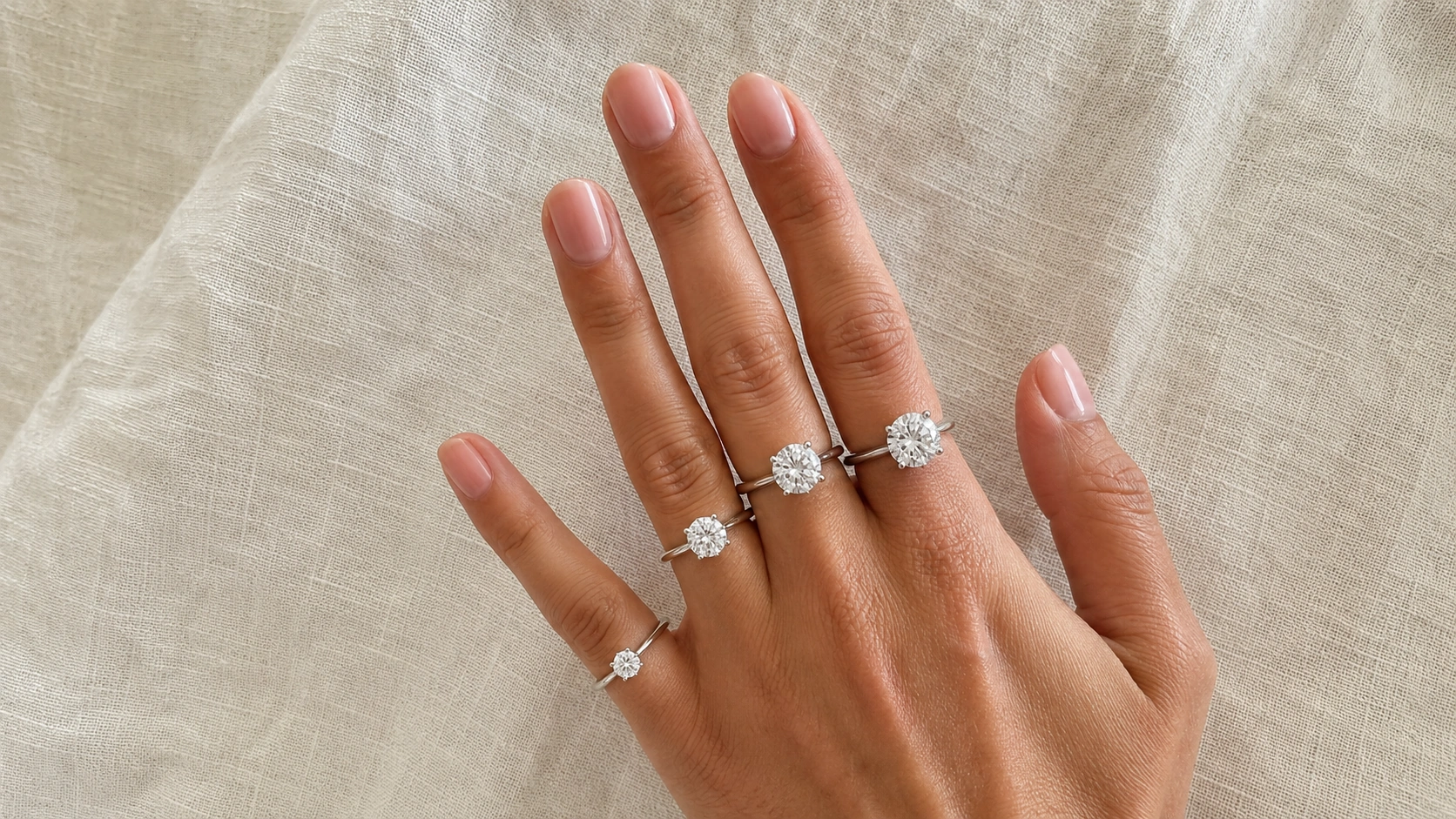
Once you have the millimeters, the next question is how those millimeters read on an actual hand. Finger width changes everything. A 6.5 mm round looks generous on a slender size-4 finger and more moderate on a size-8. The same stone, the same millimeters, two different impressions.
As a loose framing, a 0.5ct round (around 5 mm) tends to read as subtle and close to the finger, comfortable for people who want something they barely notice through the day. Around 1ct (roughly 6.5 mm) sits in the balanced zone for most hands, clearly visible without dominating. From about 1.5ct upward (7.4 mm and beyond), stones move into bolder territory and start to draw the eye on their own.
These are tendencies, not rules. A “subtle” stone on one hand is a “balanced” stone on another, and band width plays in too. A thin band makes a center stone look larger by contrast, while a wide or heavily detailed band can make the same stone look smaller. If you’re comparing options, hold the millimeter figure against your own ring size before you trust any photo.
One more warning about photos: phone cameras and product shots routinely distort scale. Macro lenses, close crops, and bright studio lighting all push stones to look bigger than they wear in person. A side-by-side video on a real hand, filmed at a normal distance, is worth more than a dozen zoomed-in stills.
Cut shape can make the same carat look bigger or smaller
Carat and millimeters get you most of the way, but shape is the lever people forget. Two stones of identical weight can present very different face-up sizes depending on how the cutter distributed that weight. Some shapes spread wide and shallow; others carry weight down in the depth where you can’t see it.
This is one of the easiest ways to get more visible size for the same weight, and it costs nothing extra to choose well.
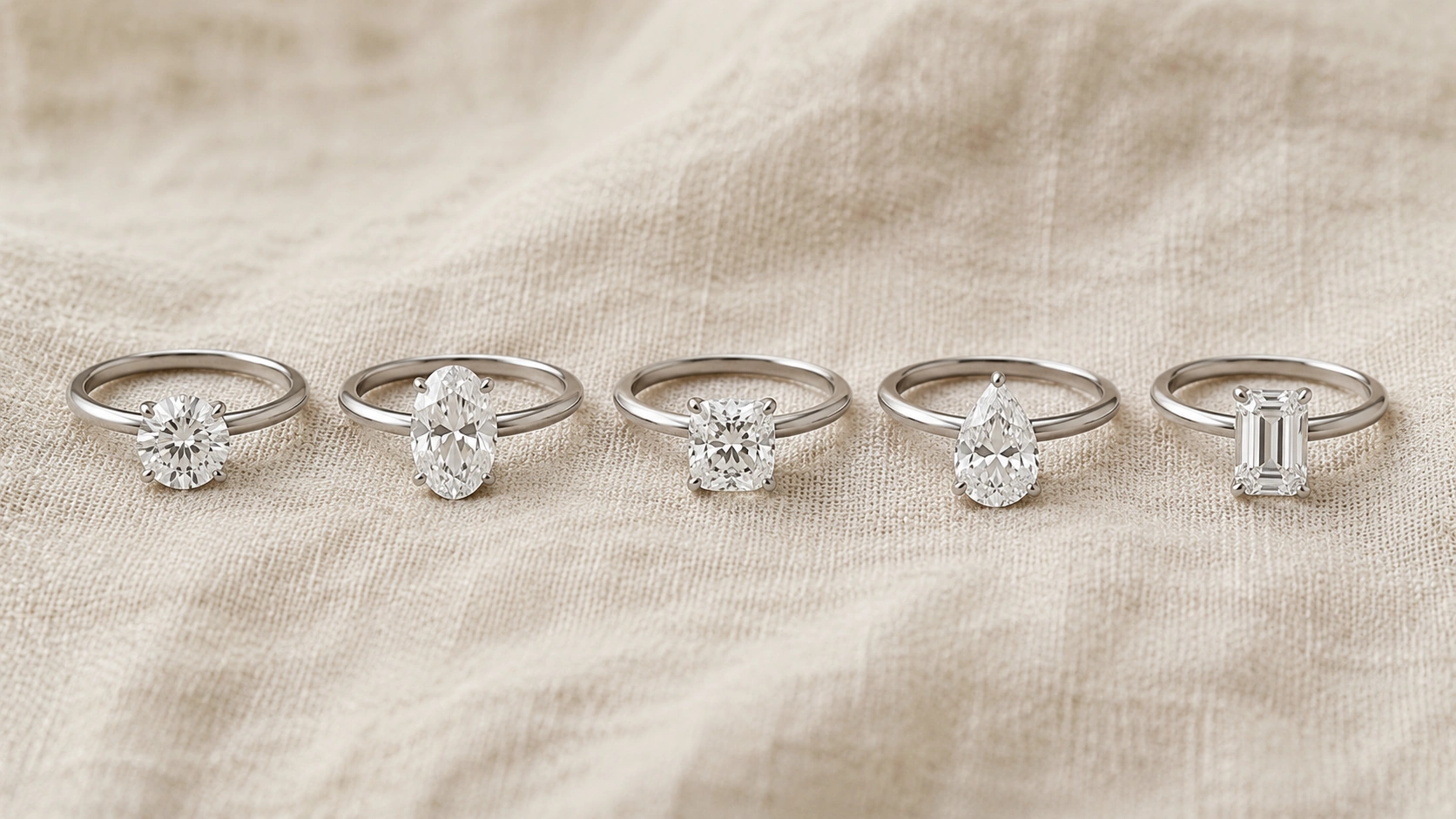
Round versus elongated shapes
Round brilliants are cut for maximum sparkle, which means a fair amount of their weight sits in the depth of the stone. They’re beautiful, and they’re also one of the less size-efficient shapes per carat from a pure face-up standpoint.
Elongated shapes – oval, pear, and marquise especially – spread their weight across a longer surface. A 1ct oval typically looks larger than a 1ct round because the eye reads its length, and elongated stones also have a slimming, finger-lengthening effect that many people like. Marquise, the most elongated of the common shapes, often appears largest of all at a given weight.
Emerald and radiant cuts sit somewhere in between, with broad open tables that can read large for their weight when well proportioned. If maximizing visible spread is your priority, an elongated or open-table shape will generally give you more apparent size per carat than a round.
Deep versus broad cuts and where weight hides
Within any shape, a stone can be cut deep or shallow, and that changes the math. A deeply cut stone concentrates weight below the surface, so it weighs more than its face-up size suggests, and you’re paying for carats you can’t see. A stone cut for a broader spread shows more width per carat, though cutting too shallow eventually costs sparkle and light return.
This is why two 1ct stones of the same shape can measure differently across the top. When you’re comparing, ask for the millimeter dimensions, not just the carat weight. The millimeters tell you what you’ll see; the carat tells you what you’ll pay to lift.
Diamond and moissanite sizing: where they match and where people get confused
Diamond and moissanite are close enough in density that, at the same millimeter size, they look nearly identical in scale. A 6.5 mm round reads the same on the hand whether it’s a lab diamond or a moissanite. The confusion comes entirely from how moissanite is sold.
Moissanite is slightly less dense than diamond, so a moissanite cut to a given width weighs a bit less in actual carats than a diamond of the same width. To avoid making shoppers do conversion math, most sellers list moissanite by DEW, or diamond equivalent weight. DEW is shorthand that means “this stone is the same face-up size as a diamond of this carat weight,” even though the moissanite’s true weight is a little lower.
A practical example: a 6.5 mm moissanite is commonly sold as “1ct DEW” because it matches a 1ct diamond’s spread, while its actual weight is closer to 0.88ct. Neither number is wrong; they’re describing different things. DEW describes the look, actual carat describes the mass.
Our recommendation is to ignore the carat-versus-DEW debate and communicate in millimeters whenever you can. If you tell us you want a 7 mm round center, we know exactly what you’ll see on your hand regardless of whether you choose lab diamond or moissanite. Millimeters remove the ambiguity that DEW language can introduce. (If you’re still weighing the two materials themselves, our lab diamond vs moissanite comparison covers sparkle, hardness, and price in detail.)
Further reading: Diamond vs Moissanite: The Honest Comparison in 2026
Sapphire, ruby, and emerald: same carat, different visual size
Colored stones are where carat-only thinking falls apart completely, and it comes down to density. Sapphire and ruby are both corundum, a notably dense material, so they pack more weight into less width than a diamond does. Emerald is a type of beryl, which is less dense than diamond, so it does the opposite.
In plain terms: at the same carat weight, a sapphire or ruby faces up smaller than a diamond, and an emerald faces up about the same or slightly wider. The carat number is steady; the size your eye sees is not.
Here’s an approximate comparison at 1 carat, all cut as rounds, to illustrate the spread. These are ballpark figures meant to show the direction of the difference, not exact specifications.
| Stone (1ct round) | Approx. face-up diameter |
|---|---|
| Ruby / sapphire | about 6.0 mm |
| Diamond / moissanite | about 6.5 mm |
| Emerald | about 6.5 mm |
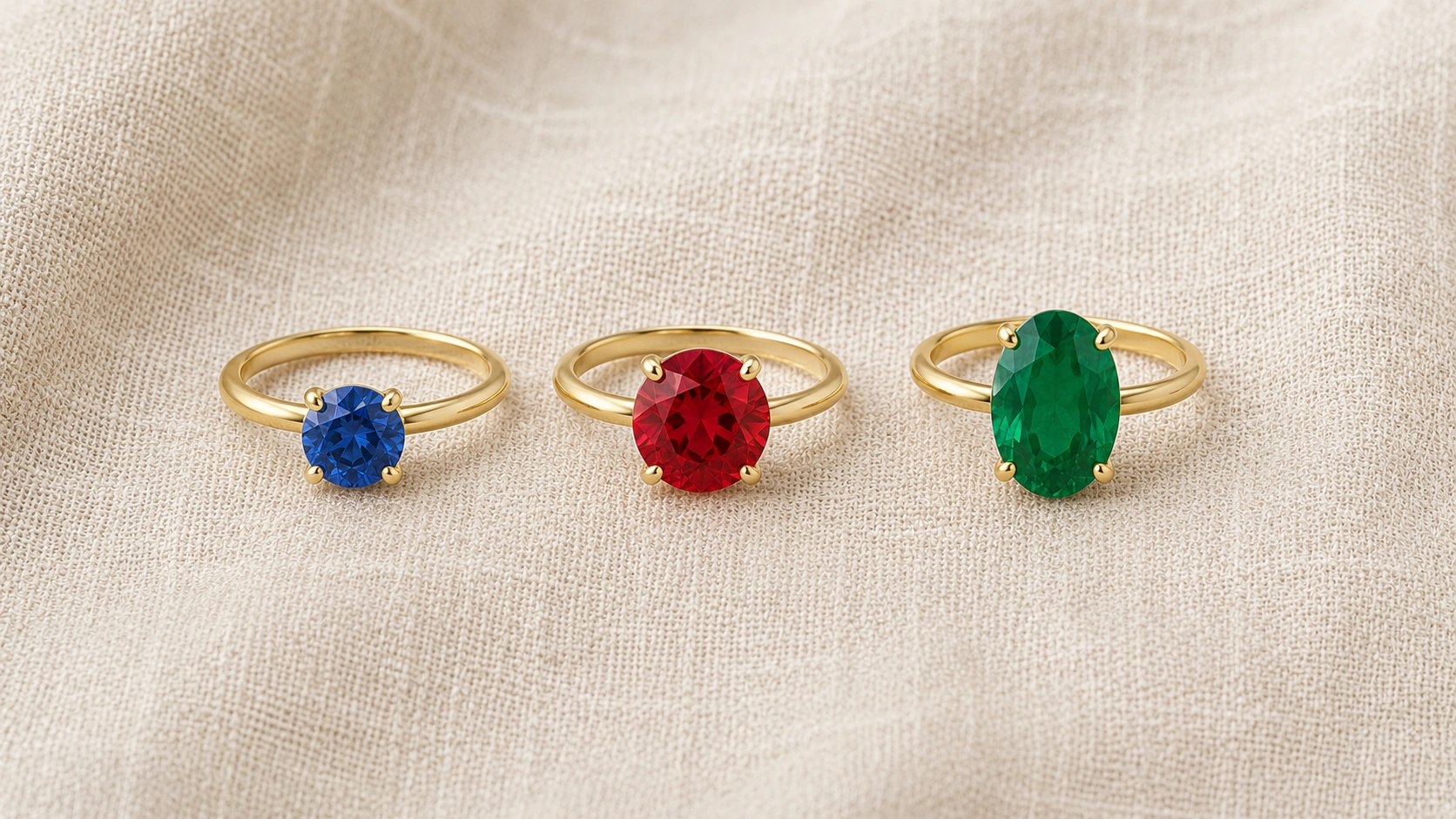
It looks small on paper, but half a millimeter of diameter is visible in person, and the gap widens at larger sizes. A 2ct ruby is meaningfully narrower than a 2ct diamond. This is why we steer colored-stone buyers toward millimeters from the very first message. If you fall in love with a 1ct sapphire in a photo, what you actually loved was its millimeter spread in that specific stone, and matching the carat alone may not get you the same look.
There’s a second wrinkle worth knowing: colored gems are often cut to preserve weight or to show color at its best, not purely for spread. That’s a reasonable trade-off, since color saturation is most of what makes a colored stone beautiful. Just go in knowing that carat is an even looser guide to size here than it is with diamonds.
Best size by jewelry type
There’s no single “right” size, only the right size for a particular piece worn by a particular person. The same stone that feels generous in a pendant can feel modest in a cocktail ring. Below are practical ranges we use as starting points, framed in diamond or moissanite terms; shift them down a touch in millimeters if you’re working with sapphire or ruby.
Engagement rings
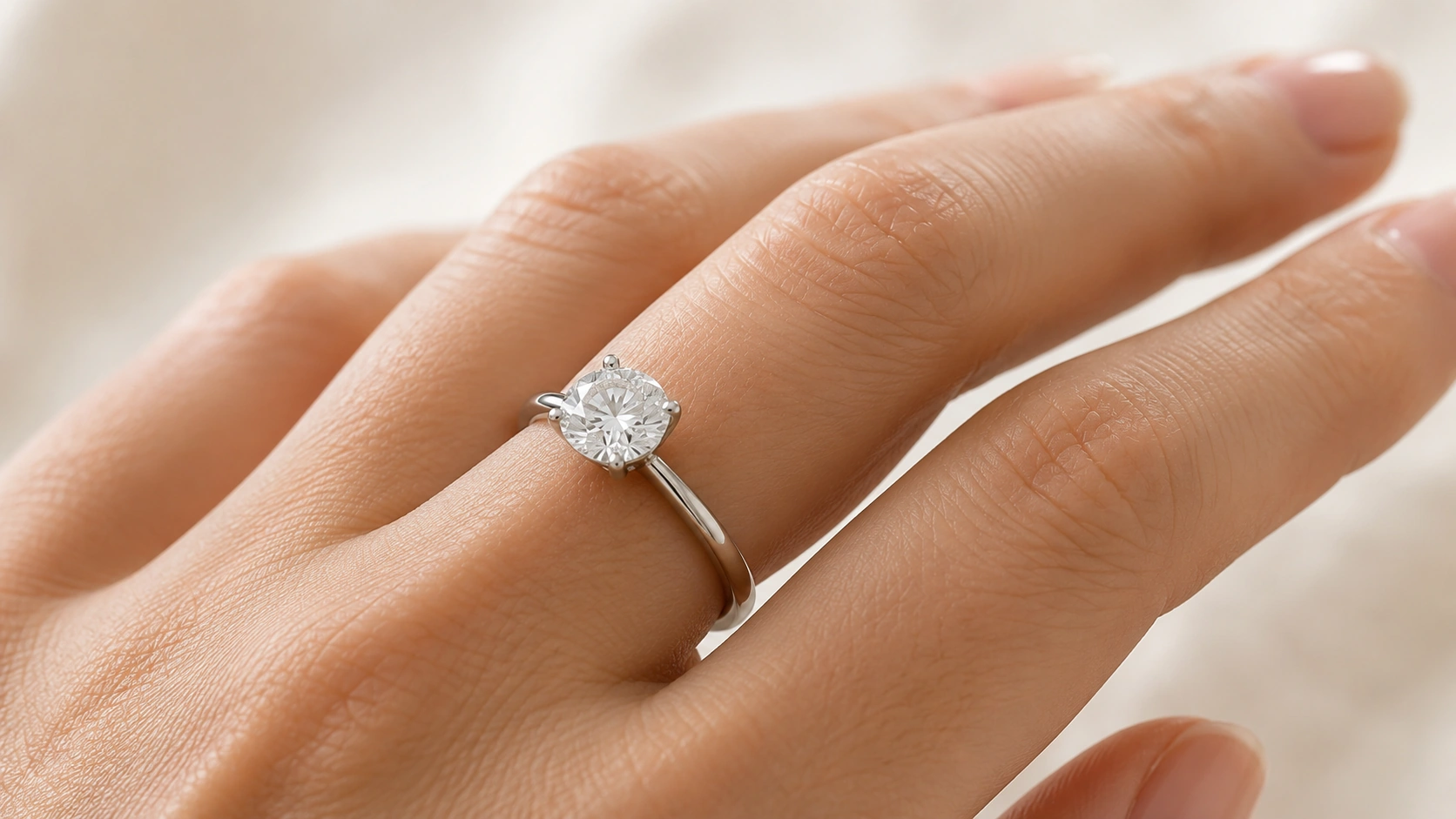
For a center stone, most buyers land somewhere between subtle and bold depending on hand size, lifestyle, and taste. As a rough map, roughly 0.5 to 0.8ct reads subtle and sits close to the finger, around 0.9 to 1.5ct is the balanced zone where most people feel the stone is clearly present without taking over, and 1.6ct and up moves into bolder territory.
Lifestyle matters as much as looks. A taller setting and a larger stone catch on gloves, hair, and pockets, and they sit higher off the finger where they meet door frames and gym equipment. If you work with your hands, type all day, or just dislike fuss, a slightly smaller stone in a lower setting often wears better than a bigger one you’re constantly aware of. None of that makes a big stone wrong; it just makes the choice about your days, not a number.
Further reading: How to choose an engagement ring: every decision explained
Stud earrings
Studs sit farther from the viewer than a ring and against the larger backdrop of your face and hair, so they read smaller than the same stone would on a hand. That’s why earring sizes are usually quoted per ear, and why a pair that looks modest in the box often looks right once on.
As a starting range, around 0.25 to 0.4ct each reads subtle and everyday, 0.5 to 0.75ct each is a comfortable balanced choice for most people, and 1ct each and up is clearly visible from across a room. Symmetry matters more than size here: a matched pair within a tight weight and color range looks far more considered than two slightly mismatched larger stones.
Pendants and necklaces
A pendant hangs well below eye level and is viewed from a distance, so it needs more size than a ring to register with the same presence. A stone that looks generous up close on your finger can look surprisingly small once it’s sitting at the sternum.
For a piece you want noticed in daily wear, many people find that something in the 0.8 to 1.5ct equivalent range carries well, while a true minimalist everyday pendant can sit comfortably lower, around 0.3 to 0.7ct. Chain length and skin contrast play in too, so think about where the pendant actually lands on you.
Bracelets and tennis styles
Bracelets, and tennis styles in particular, are less about any single stone and more about the line of stones as a whole and how the piece feels in motion. Here the priorities shift toward comfort, profile height, and durability. A line of stones set too high snags constantly and rolls on the wrist, while a lower, well-secured profile wears smoothly for years.
For these pieces, we’d rather talk with you about total carat weight across the design, setting security, and how the bracelet drapes than push any single per-stone size. The right answer is the one that disappears into your day instead of demanding attention from it.
What different sizes “signal,” without the nonsense
Plenty of jewelry marketing wants you to believe size communicates status, commitment, or taste, and that bigger always says more. It doesn’t, and the people whose opinions you actually care about aren’t measuring your ring.
A more useful way to think about it: smaller, close-to-the-hand stones tend to read as minimal and understated, mid-range stones read as classic and broadly versatile, and larger stones read as bold and more eye-catching. None of those is better than the others, and all of them are completely valid depending on the wearer and the setting they live in.
Context is worth a thought, though. If you wear gloves at work, handle equipment, or simply prefer not to draw attention, a lower-profile size in a secure setting may suit your life better. If you love the look of a bold stone and your days allow for it, that’s an equally good reason. Match the size to the person who wears it, and the supposed “signal” takes care of itself.
Common sizing mistakes, and how to avoid them
The errors we see most often come from trusting the wrong signal. Buying by carat alone is the big one, because it ignores the millimeter spread and the cut depth that actually determine what you see. Two stones at the same weight can look noticeably different across the top, so always ask for the dimensions.
A close second is ignoring shape. People fix on a carat number, choose a round out of habit, and never realize an oval or emerald cut at the same weight would have given them more visible size and a different feel. Shape is a free lever; use it before you spend up for extra carats.
The third is treating zoomed-in phone screenshots as truth. A macro shot on a stranger’s hand tells you almost nothing about how a stone wears on yours. Validate with a comparison video filmed at normal distance, and where possible against your own ring size and finger width. Taking a few extra days to test the size against real references costs nothing and prevents the most common regret in the whole category.
A practical 6-step process to pick your stone size
If you want a repeatable method instead of guesswork, this is the sequence we’d walk through with you.
- Pick the jewelry type and how you’ll wear it. A ring you wear daily at a keyboard has different needs than earrings for occasional evenings.
- Set a visual target. Decide whether you’re after subtle, balanced, or bold, in honest terms for your own hand and lifestyle.
- Convert that target to a millimeter range. Use the round-stone anchors above as your baseline, and adjust for shape and gem type.
- Choose your cut shape. Decide whether you want round’s classic look or the wider spread of an elongated or open-table cut, knowing it changes apparent size at the same weight.
- Validate against real references. Check your millimeter target on your own ring size, and watch an on-hand comparison video before committing.
- Finalize by comfort and budget. Confirm the setting height and stone size feel right for daily wear, then let the carat figure and price fall out of those decisions rather than driving them.
Frequently asked questions
What carat size looks the biggest for the money?
For pure face-up size per carat, elongated shapes like oval, pear, and marquise generally look larger than a round of the same weight, because they spread their weight across a longer surface instead of hiding it in depth. Choosing the shape carefully is usually a better way to maximize visible size than simply paying for more carats.
Does a 2 carat stone look twice as big as a 1 carat?
No. Carat measures weight, and weight grows in three dimensions, so doubling the carat only widens the face-up diameter by roughly 25 to 30 percent. A 1ct round is about 6.5 mm across and a 2ct round is about 8.2 mm, which is clearly larger but nowhere near double the width.
Why does my 1 carat sapphire look smaller than a 1 carat diamond?
Because sapphire is denser than diamond, so it packs more weight into less width. At 1ct a sapphire faces up around 6.0 mm versus roughly 6.5 mm for a diamond. With colored stones especially, it’s better to choose by millimeter size than by carat weight.
What’s the difference between carat and DEW for moissanite?
DEW stands for diamond equivalent weight. It tells you the diamond carat size a moissanite matches in face-up appearance, even though moissanite’s true weight is slightly lower because it’s a little less dense. A 6.5 mm moissanite is sold as 1ct DEW but weighs closer to 0.88ct; both numbers are accurate, they just describe size versus mass.
What’s the best carat size for an engagement ring?
There isn’t a universal answer, because it depends on hand size, the setting, your daily activities, and your taste. As a starting frame, many people find the balanced zone around 0.9 to 1.5ct works well, but a smaller stone can suit an active lifestyle and a larger one suits someone who wants more presence. Choose the size that fits the person wearing it.
Should I choose a stone by carat or by millimeters?
Millimeters, in almost every case. Carat tells you weight and therefore price, but millimeters tell you what your eye actually sees on the hand, ear, or neck. This is doubly true when comparing different gem types or different cuts, where the same carat can look quite different.
Do colored stones and diamonds use the same size chart?
No, and using a diamond chart for a ruby or emerald will mislead you. Ruby and sapphire are denser than diamond and face up smaller per carat, while emerald is less dense and faces up about the same or slightly wider. Always ask for the actual millimeter dimensions of a colored stone.
Why do stones look bigger in photos than in person?
Macro lenses, tight crops, and bright studio lighting all exaggerate scale, so product photos and close-up phone shots routinely make stones look larger than they wear. A video filmed on a real hand at normal viewing distance is a far more reliable guide to true size.
Before you settle on a number
Sizing is one of the few decisions in jewelry that’s genuinely hard to judge from a screen, so we don’t expect you to nail it alone. Send us your ring size, the kind of piece you have in mind, your preferred style, and a rough budget, and we’ll come back with a transparent size recommendation in millimeters – including the honest trade-offs between spread, shape, and cost.
You’ll see a 3D render and a video of the finished piece before any payment is due, so the size you approve is the size you get. Request a quote whenever you’re ready, and we’ll talk it through.