Most jewelry buyers have a vague sense that the price on the counter has very little to do with what’s actually in the box. They’re right. The retail tag on a ring or necklace is the end of a long calculation that includes the gold, the stone, the labor, the lease, the staff, the marketing, the returns, the inventory loan, and a brand fee that has nothing to do with how the piece looks.
This article does what most jewelry-buying guides won’t do. It breaks that stack into its actual layers, then runs the math three different ways. First through the lens of a traditional storefront, then through the lens of a large online retailer like James Allen or Blue Nile, then through the lens of a made-to-order atelier like ours.
The aim is simple. When you next get quoted on an engagement ring, a wedding band, or a milestone piece, you should be able to look at the number and roughly know where each dollar of it is going.
The pricing stack most buyers never see
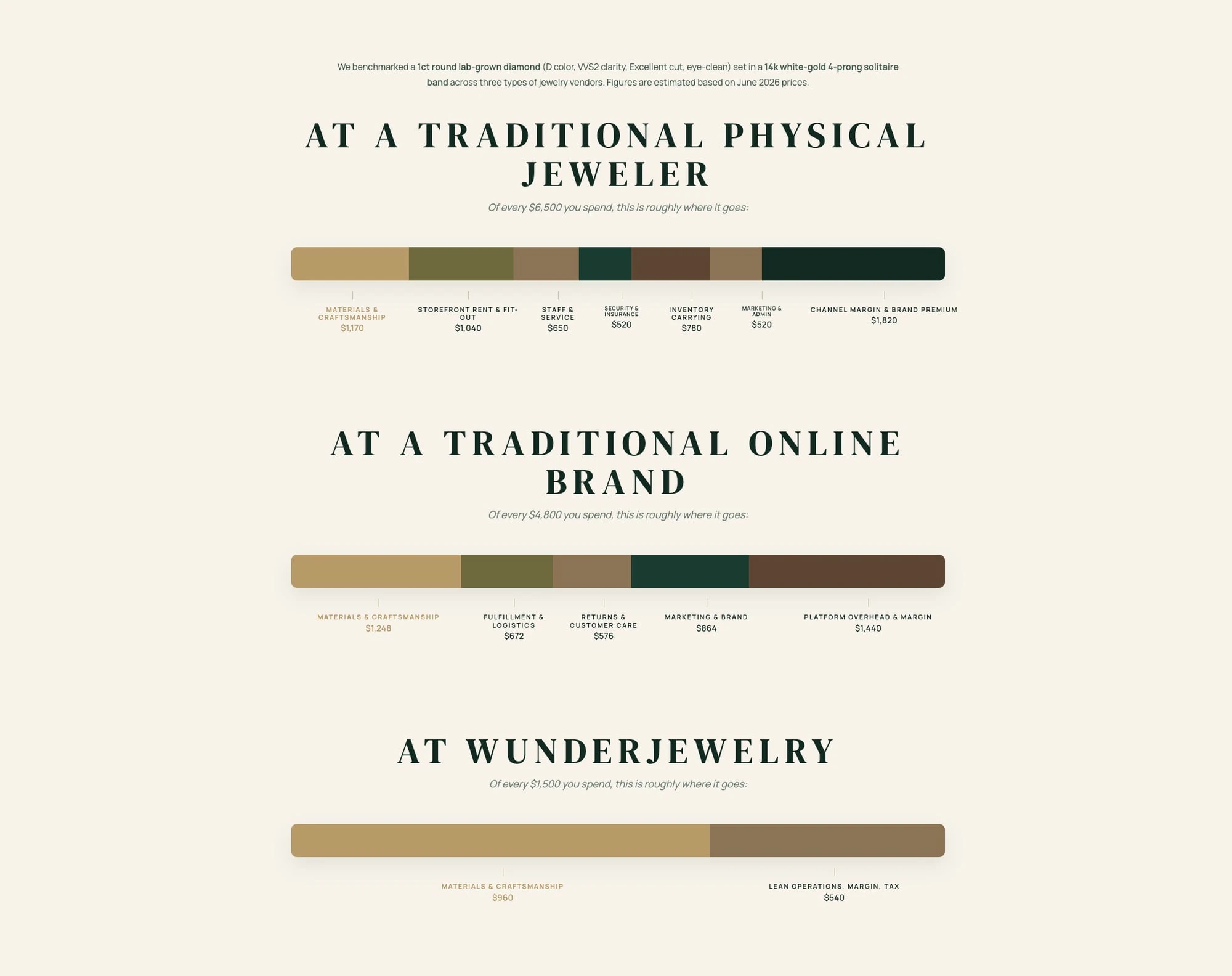
Before splitting by channel, it helps to see the full menu. Every jewelry business – whether it’s a Mayfair storefront, a venture-backed e-commerce platform, or a small atelier – pays for some subset of the following.
Materials sit at the bottom of the stack. Metal is priced against the spot market for gold or platinum, and the per-gram cost can be looked up on any given day via the World Gold Council and similar bullion references. Stones have benchmarks too. The Rapaport Diamond Price List is the long-standing reference for diamond wholesale pricing inside the trade, even if consumers rarely see it directly.
Craft labor sits on top of materials. This is the designer’s time, the goldsmith’s hours at the bench, the setter’s micro-precision under a microscope, and the polisher’s final pass. A plain solitaire is fast. A pavé band with thirty melee stones is not.
Then comes everything around the piece. Quality control, hallmarking (regulated in the UK by bodies like the Assay Office London), gemological certification through labs like IGI or GIA, insured shipping, and the cost of returns handling. None of this is glamorous, but all of it costs real money.
Then the business overhead. Rent on retail real estate. Staff salaries. Security and loss prevention. Inventory financing, because jewelry sitting in a case is capital that isn’t earning anything. Marketing. Customer acquisition. Software. Legal. Insurance on the stock itself.
Finally, the margin layer. This is what’s left for the brand. The gross margin becomes the operating cushion, and after every cost above is subtracted, the net margin is what the business actually keeps.
Gross margin is selling price minus the direct cost of the goods. Net margin is what’s left after everything – rent, staff, ads, returns, the lot. They are not interchangeable, and confusing them is how customers end up assuming a high gross margin equals high greed. Sometimes it does. Often it just means the business has a lot of mouths to feed before it sees a profit.
Further reading: Gold purity explained: from 9k to 24k
Traditional physical jewelry stores and local goldsmiths
Storefront retail is the oldest model in jewelry and the most expensive to run. Walk into a shop on Bond Street, the Champs Élysées, or Times Square, and the price on the case is paying for a lot more than the piece inside it.
The first thing storefronts pay for is real estate. The second is the experience built around it. Then the inventory that fills the cases.
What a storefront actually costs to operate
Take a central London style example. A prime jewelry corridor commands real estate rents that can run into the high hundreds of pounds per square foot annually, sometimes higher. A modest shop of around 1,000 square feet can mean an annual lease commitment in the mid six figures before utilities, business rates, or fit-out costs. Insurance for a stocked jewelry shop is its own line item, and security – physical and electronic – is mandatory at this tier.
Staffing follows. A traditional jewelry shop is a relationship business. You need experienced sales associates, often on commission, a manager, security personnel, and back-of-house support for repairs, sizing, and aftercare. Headcount alone in a small flagship can run well into six figures annually in fully loaded cost. These are estimates intended to illustrate orders of magnitude, not specific quoted figures from any particular business.
Then inventory. A stocked showroom needs pieces in the case to show. Those pieces are bought or financed at wholesale, and they sit. Capital tied up in unsold inventory is one of the least visible costs in retail jewelry, and one of the most consequential. A piece that sits for eighteen months has cost the business interest, insurance, and opportunity cost the entire time.
Add marketing – local press, lifestyle sponsorships, partnerships, window displays, holiday campaigns – plus the cost of returns, repairs, and the long tail of customer service that comes with selling something people wear for decades. Every one of those costs has to be recovered through the markup on the pieces that do sell.
Goldsmith economics and where the value is real
It’s worth separating brand storefront economics from independent goldsmith work, because they’re different businesses operating under the same roof category.
A working goldsmith – the kind who actually sits at a bench rather than running a showroom – earns money on craft. The labor in a setting, the precision in a finish, the design eye that makes a piece work on a hand rather than just on paper. When you commission a custom piece from an independent goldsmith, a large share of what you pay goes to actual skilled human time. That’s a legitimate cost and one we’d never argue against.
The trouble starts when brand premium grafts itself onto craft. A storefront-driven brand might charge five or eight or ten times wholesale on a piece that involved no more craftsmanship than a smaller atelier would have charged twice wholesale for. The piece looks the same. The hours at the bench were the same. The price reflects the rent on the street and the photo shoot in the window, not the work in the metal.
Where overpayment tends to live in the storefront model
You generally pay for storefront retail in three ways. First, the rent and staffing baked into every price tag. Second, the inventory financing on pieces that aren’t yours. Third, the brand premium, which has no visible signature on the piece itself – you’d never see it in a blind side-by-side with a comparable atelier piece.
That doesn’t make storefront retail wrong. Some buyers genuinely value the experience – walking in, trying things on, having a long conversation with a knowledgeable associate, leaving with the piece in a bag the same day. If that matters to you, the premium is buying something real. Just know what you’re buying.
Large online retailers (James Allen, Blue Nile, and the publicly traded model)
The second model is the scaled online retailer. Brilliant Earth runs as an independent public company. Blue Nile and James Allen sit inside Signet Jewelers, the largest specialty jewelry retailer in the US, which discloses figures across its portfolio in quarterly and annual investor releases.
Online removes some costs. It does not remove all of them, and in a few places it adds new ones.
What online retail strips out and what it keeps
The most obvious savings come from real estate. Online retailers don’t need a flagship shop on every premium high street. Inventory often consolidates into central locations, frequently handled through virtual inventory models where a stone is reserved from a supplier only once a customer orders it. That’s a meaningful structural saving versus a storefront.
What online doesn’t remove is the rest of the business. Customer acquisition is the dominant cost line for direct-to-consumer brands in this category. Paid search on terms like “engagement ring” and “lab grown diamond” is among the more expensive ad inventory on the internet. Add SEO investment, content production, affiliate programs, and the cost of building a recognizable brand at internet scale, and the marketing line item is large.
Returns are the other quiet cost. E-commerce return rates are higher than in-store, and for high-value sized items like rings, every returned piece carries shipping insurance, inspection, restocking, and the risk of damage in transit. A return that becomes a refund is a marketing dollar that bought nothing.
Then there’s platform investment. Imaging studios for 360-degree stone views, virtual try-on tools, customer service teams, and engineering. Online jewelry retail is closer to a software business than most people realize.
Reading public filings without getting fooled
Signet’s and Brilliant Earth’s investor disclosures show meaningful gross margin in both physical and online-led jewelry retail. Anyone can pull the latest filings from each company’s investor relations pages and read the numbers directly. We’d encourage you to.
What’s worth understanding is the gap between gross and net. A jewelry retailer can post a healthy gross margin and still be running a thin or even negative net margin once marketing, real estate, staffing, and corporate overhead are subtracted. High gross margin in this industry is what keeps the lights on; on its own, it isn’t a sign the brand is pocketing the spread.
That’s the honest reading. Online retailers do operate at meaningful gross margin levels. They also burn a large portion of that on customer acquisition, technology, and returns. The number on the price tag is the result of both.
The WunderJewelry model
The third model is the one we run, and we’ll describe it the way we’d describe any other – by the costs that are in it and the costs that aren’t.
WunderJewelry is a made-to-order atelier. We don’t hold inventory. We don’t operate retail storefronts. We don’t pay for window displays in expensive postcodes, and we don’t finance unsold stock. When a customer sends a brief, we quote, render, craft, and ship – once, for that customer, against their specific design.
How made-to-order changes the cost structure
The biggest structural saving is inventory. A traditional retailer’s largest single capital line is the merchandise sitting in the case. Ours is essentially zero. We buy materials only against confirmed orders, which means we don’t carry the interest, insurance, or opportunity cost on hundreds of thousands of dollars of stock.
The second saving is real estate. We have an office and an atelier, not a flagship. The third is sales staffing – our process is quote-driven rather than commission-driven, so we don’t have a floor team paid to close deals. We have designers, master goldsmiths, and a small communications team.
Production sits in a master goldsmith atelier in China, which we’re upfront about. The narrative that “Europe equals quality, China equals cheap” is outdated – some of the best fine jewelry work in the world today happens in Chinese ateliers using equipment and techniques on par with anywhere else. The cost difference versus comparable European production is real and goes into the customer’s price, not into a brand fee.
What customers should still expect to pay for
What we still pay for, and should, is what any honest jewelry business pays for. Real materials at honest costs (gold at spot, lab-grown stones at fair wholesale, certification through IGI for stones at 0.5ct and above). Genuine craft hours at the bench. Two stages of quality control before the customer pays – a 3D render approval and a finished-piece video approval. Fully insured worldwide shipping. None of those costs should disappear from a jewelry quote. If they do, something else is wrong.
We’re a business with a margin. We’re transparent about its rough shape. Traditional retail markups in fine jewelry are often cited in the 4–10x wholesale range, and we operate closer to 2x. That is the headline difference between our quotes and a comparable storefront quote, and it’s structural rather than promotional.
You’re also paying for the process – the 48-hour quote turnaround, the design and render work, the finished-piece video, the QC reviews before any money changes hands. None of that is free to run. It’s just cheaper than the alternative of holding inventory and renting on a luxury street.
A side-by-side view
Here’s the same piece, conceptually, run through all three channels. Numbers are illustrative ranges, not promises.
A solitaire ring with a 1.5ct lab-grown diamond and a 14k gold setting has a roughly knowable material and labor cost. That underlying figure might land in the low four figures, give or take, depending on stone specs and setting complexity.
A storefront brand on a premium high street might price the same piece at six to ten times that underlying cost, depending on the brand. The buyer is paying for the showroom experience, the in-store staff, the inventory financing, and the brand premium baked into every tag.
A large online retailer might price it more narrowly, often two to four times underlying cost depending on the retailer and the stone, with the spread going to marketing, returns, and technology rather than rent.
A made-to-order atelier like ours would price the same configuration closer to twice the underlying cost, with the difference accounted for by an honest margin on a leaner business. The piece itself is the same metal, the same stone grade, and the same craft hours. The difference is the rent, the staffing, the marketing, and the brand fee that don’t apply.
How to audit any jewelry quote in five questions
A useful side effect of understanding the layers is being able to pressure-test any quote you receive. Five questions in particular do most of the work.
First, ask for the material spec in writing. Metal type, weight, stone count, stone size, stone grade, certification body. If a quote dodges these, that tells you something.
Second, ask whether the price tracks materials and labor or whether you’re paying primarily for the brand. There’s no wrong answer – some buyers want the brand – but you should know which you’re choosing.
Third, ask what quality controls happen before payment, not after. Warranties cover defects you discover later. Pre-payment QC catches them before money changes hands. Both can be valuable, only one is preventative.
Fourth, ask about returns and remediation. What happens if the delivered piece doesn’t match the spec? Who pays for what? In what timeframe?
Fifth, ask why this particular quote is the price it is. A vendor that can explain pricing in line items is one operating in daylight. A vendor that can only say “this is the price” is one operating on opacity. We’d take the first one every time.
Further reading: Best diamond grade for value: how to maximize beauty per dollar
Our honest take
Paying more for jewelry can be entirely rational. A vintage piece with provenance, a one-of-a-kind designer commission, a piece you genuinely fall in love with at a specific shop where the experience is part of the memory – these are valid reasons to spend at the high end.
Where we’d push back is the default assumption that the highest price tag means the best piece. In jewelry, that assumption breaks down faster than in almost any other category. Two rings with identical metals, identical stones, and identical workmanship can sit on different shelves at radically different prices. The shelf is what’s different, the piece often isn’t.
The honest move, before any purchase in this category, is to know what you’re paying for. If you can explain your quote in line items, you’re buying a piece. If you can’t, you’re buying a story.
Frequently asked questions
Why is jewelry so expensive in physical stores?
Physical jewelry retail carries layered costs that don’t apply elsewhere. Rent on premium real estate, security, sales staff on commission, insurance, and inventory financing on unsold stock. A traditional storefront has to recover all of that through its markups, which is why physical retail pricing typically lands at the higher end of the ratio range versus wholesale.
What’s the difference between gross margin and net margin in jewelry?
Gross margin is selling price minus the direct cost of the piece. Net margin is what’s left after every other cost – rent, salaries, marketing, returns, corporate overhead – is subtracted. A jewelry retailer can post strong gross margins and still earn a slim net margin once everything is paid for. Both numbers tell you something different, and they’re often confused in conversations about jewelry pricing.
Are online retailers like Blue Nile or James Allen cheaper than traditional jewelers?
They often are, for a piece with the same materials and specs, because they avoid the cost of operating premium retail storefronts. They still spend significantly on marketing, technology, and returns handling, which is why their prices aren’t as low as the structural savings might suggest. Signet Jewelers, which owns both Blue Nile and James Allen, discloses its financial structure in its investor releases for anyone who wants to read the numbers directly.
What is a fair markup for fine jewelry?
There’s no universal answer, but there is a reasonable range. Traditional storefront retail markups in fine jewelry are commonly cited in the 4–10x wholesale range. Scaled online retail tends to operate in a narrower band. Made-to-order ateliers can operate closer to 2x. A “fair” markup depends on what services and overhead are inside the price.
Why does an engagement ring cost so much more than the materials in it?
Because a finished ring includes more than metal and stone. You’re paying for design, casting, setting, finishing, certification, quality control, packaging, insured shipping, and the channel costs of whoever sold it to you. In many cases the raw material itself is a minority of the final price you see.
Further reading: How to choose an engagement ring: every decision explained
How do I know if I’m being overcharged?
Ask for a line-item explanation of the quote and compare it across at least two other channels with the same specs. If a vendor can’t explain the price in terms of materials, labor, and overhead, or if the spread between their quote and a comparable atelier’s quote runs in multiples rather than percentages, you have your answer.
Is custom jewelry always cheaper than retail?
Not always, but it often is for comparable materials and craft, because custom and made-to-order models avoid most inventory and storefront costs. Custom can also be more expensive when the piece itself requires more labor than a stock piece would – complex design hours, intricate setting work, unusual stone sourcing. The savings come from the channel, not from cutting corners on the work.
Do markups vary that much between brands selling similar pieces?
Yes, and that’s the whole point of pulling quotes from more than one channel. The materials and the craft can be near-identical between a high-street brand and an atelier piece, while the prices differ by a multiple. The gap is overhead, marketing, and brand premium – none of which lives in the piece itself.
If you want a quote
Send us your idea – a reference image, a sketch, a description, a budget if you have one. Within 48 hours we’ll come back with two or three honest configurations, with the materials, the craft, and the margin laid out in line items. No pressure to proceed. If our model isn’t right for you, you’ll at least leave the conversation able to read your other quotes a lot more clearly.