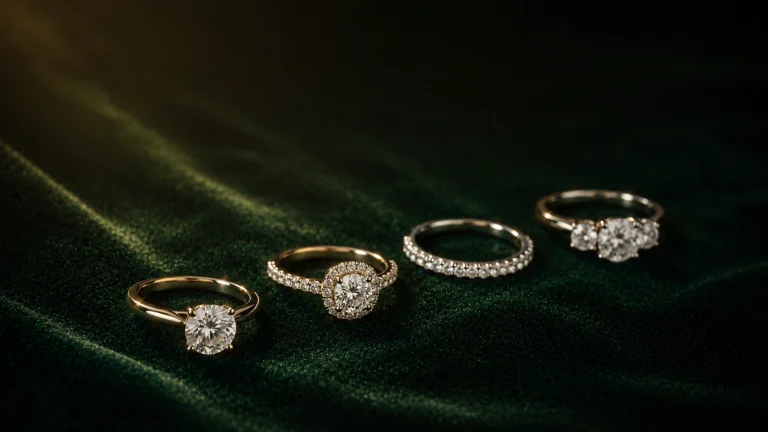
If you’re shopping for an engagement ring or a serious piece of fine jewelry, you’ve probably been handed a version of this story: natural diamonds are the real thing, lab-grown diamonds are the budget substitute, and choosing between them says something about you. That framing is doing a lot of work, and most of it is doing work for the seller, not for you.
Here’s the cleaner version. A lab diamond and a natural diamond are the same material. The differences that actually exist between them are real, but they live in economics, supply, and symbolism rather than in the stone you’d wear on your finger. Some of those differences might genuinely matter to you. Some were manufactured to matter.
This article walks through what’s identical, what’s different, and where your own preference ends and inherited industry conditioning begins. We make jewelry with lab-grown stones, so we have a point of view, and we’ll be upfront about it. But the goal here is to leave you better at deciding, even if you never buy a thing from us.
First, the biggest misconception: both are real diamonds
The single most common question in this category is some version of “are lab diamonds real?” The short answer is yes, and it isn’t a matter of opinion.
A diamond is carbon arranged in a specific crystal lattice. A lab-grown diamond has that same lattice, the same chemistry, and the same optical and physical behavior as one pulled out of the ground. The Gemological Institute of America, the body that more or less invented modern diamond grading, states plainly that lab-grown diamonds are chemically and optically the same as natural diamonds. They are not imitations sitting next to the real thing. They are the real thing, grown on a different timeline.
This is also why “fake vs real” is the wrong frame entirely. A cubic zirconia is a fake diamond, because it’s a different material pretending to be one. Moissanite is a separate stone with its own properties, not a diamond at all, though it’s a beautiful option in its own right. A lab-grown diamond is none of that. Under the U.S. Federal Trade Commission’s guidance, a producer can call a lab-grown stone a diamond precisely because it has essentially the same optical, physical, and chemical properties as a mined one. The regulators settled this argument years ago.
So when someone calls a lab diamond “fake,” they’re either misinformed or selling you something. The accurate distinction is lab-grown versus mined, or lab versus natural. Real isn’t the axis that separates them.
Further reading: Diamond vs Moissanite: The Honest Comparison in 2026
What’s actually different between lab and natural diamonds
If the material is the same, where do the differences live? Mostly in three places: where the stone came from, how the supply works, and what each one costs over time. None of those show up in the sparkle, but they’re not nothing.
Origin
The honest, literal difference is age and method. A natural diamond formed deep in the earth over a span measured in hundreds of millions to billions of years, then got carried toward the surface by ancient volcanic activity. A lab-grown diamond is made in a controlled environment over a period of weeks, using one of two methods: high pressure, high temperature (HPHT), which recreates the conditions underground, or chemical vapor deposition (CVD), which builds the crystal layer by layer from a carbon-rich gas.
That’s a genuine difference in history. A natural stone is a geological artifact, and for some buyers that origin story carries real weight. We’ll come back to that, because it matters and it deserves respect rather than a sales pitch.
Supply and pricing
Here’s where the divide gets economic. Natural diamond supply is finite in any given year and tightly managed through mining operations and the companies that control distribution. Lab-grown supply is scalable: build more reactors, grow more stones. That structural difference is the engine behind almost everything you’ll notice in the market.
When supply can scale and competition increases, prices fall. That’s exactly what’s happened to lab-grown diamonds over the past several years. As manufacturing capacity grew and more producers entered, lab diamond prices dropped substantially, while natural diamond prices held up because their scarcity is actively maintained rather than incidental.
Further reading: Why premium jewelry is so expensive: the real cost of jewelry in 2026
Market behavior
The practical result is the gap you see on any retailer’s site. For a stone of comparable size and quality, a lab-grown diamond typically costs a fraction of the natural equivalent, and that gap has widened as lab production matured. The exact ratio shifts with size, quality, and the month you’re shopping, so treat any single figure with suspicion, but the direction is consistent and well documented.
This is also why the “natural is rare” argument needs a careful read. Gem-quality natural diamonds aren’t as scarce as the marketing implies; the supply is controlled to feel scarce. Lab-grown diamonds quietly proved the point. Once you can make the identical molecule at scale, the premium attached to the mined version reveals itself as a market position rather than a reflection of the material being more precious.
On the finger, what changes and what doesn’t
Step back from the chemistry and the spreadsheets for a second, because this is the part that actually affects your daily experience of the ring.
What makes a diamond look good is cut, color, clarity, and carat: the four levers that determine how a finished stone catches light and reads to the eye. A well-cut one-carat lab diamond and a well-cut one-carat natural diamond of the same color and clarity will look the same, wear the same, and last the same. Both sit at 10 on the Mohs hardness scale, so neither has an edge in durability.
The honest test is this: if a trained gemologist needs specialized equipment to tell two stones apart, the difference between them is academic for the person wearing it. Your partner can’t see “mined” when they look at your hand. Your friends can’t see it. You can’t see it. What everyone sees is the cut and the size and the way it throws light across a room.
That’s the gap we want you to hold onto. Quality on the finger doesn’t map onto the lab-versus-natural line. A mediocre natural diamond looks worse than an excellent lab one, full stop. So if your priority is the best-looking finished piece for the money you have, the origin label is close to irrelevant, and a thoughtfully chosen lab stone tends to stretch your budget much further.
Why natural diamonds still feel more meaningful to some people
None of the above means a preference for natural is wrong or unsophisticated. For a real share of buyers, the geological origin genuinely matters, and that feeling deserves to be taken seriously rather than argued away.
There’s something legitimately moving about the idea that the stone on your finger spent a billion years forming before any human existed. If that history is part of what the piece means to you, that meaning is real, and no amount of chemistry talk should bully you out of it. Symbolism doesn’t have to be rational to be valid. People keep their grandmother’s ring not because it’s the best-cut stone they could own, but because of what it represents.
We’d only ask one thing: that the preference be yours, examined and chosen, rather than absorbed. A lot of buyers feel a strong pull toward natural and assume it’s their own timeless instinct, when much of it was carefully built for them. That’s worth understanding before you spend the premium, which brings us to the uncomfortable part.
The part nobody says clearly: a lot of the emotion was installed by advertising
The belief that a diamond is the natural, obvious, essential symbol of engagement is not ancient tradition. It’s a marketing campaign, and a spectacularly effective one.
In 1947, De Beers and its advertising agency, N.W. Ayer, launched the line “A Diamond Is Forever.” Before that era, diamond engagement rings were far from universal. The campaign tied diamonds to romance, permanence, and the idea that the size of the stone signaled the depth of the commitment. It worked so well that within a generation, a custom that had been invented in living memory felt like something humans had always done.
The same machinery produced the “spend two or three months’ salary” guideline. That figure wasn’t handed down through the ages; it was a marketing benchmark designed to anchor how much people felt they should pay. The genius of all of it was making a commercial preference feel like a personal value.
We’re not saying any of this is evil, and we’re definitely not saying you’re foolish if it shaped how you feel. These campaigns worked on almost everyone, including people who study them for a living. The point is simply that wanting a natural diamond is a valid choice that’s worth making consciously, with clear eyes about which part of the desire is yours and which part was sold to you decades before you started shopping.
Lab vs natural on price, value, and resale
Two financial questions come up constantly: the upfront price and the resale value. The first is straightforward. The second is where buyers get misled most often.
On upfront cost, lab wins decisively for most people. You can buy a larger, cleaner, better-cut stone for the same money, or buy the same stone for far less and spend the difference on a better setting, a nicer metal, or nothing at all. For a value-conscious buyer, that’s the whole argument in one sentence.
On resale, the natural diamond industry leans hard on the idea that mined stones “hold their value” while lab stones don’t. Here’s the more honest framing: most jewelry of any kind, natural diamonds included, is a poor financial asset for ordinary retail buyers. When you buy at retail, you pay a markup that you immediately lose the moment you try to sell, because the next buyer or the dealer isn’t paying retail. People are routinely surprised by how little they’re offered for a natural diamond they paid full price for a few years earlier.
So yes, in relative terms a natural diamond may retain more of its value than a lab one, partly because lab prices keep falling as production scales. But “retains more” is not the same as “is a good investment,” and most retail buyers of either type still take a significant loss if they sell. We’d rather you hear that now than discover it later. If you want something that appreciates, that’s what financial markets are for. Jewelry is for wearing, and the smartest move is to pay a fair price for something you’ll love for decades, not to treat the purchase as a portfolio decision. Any retailer promising you resale upside on a diamond is selling comfort, and you should price that comfort at zero.
So which one should you choose?
There’s no universally correct answer here, only the answer that fits what you actually value. The useful move is to be honest with yourself about which camp you’re in.
Further reading: Best diamond grade for value: how to maximize beauty per dollar
Choose lab-grown if
You want the most beautiful finished piece your budget allows, and you care more about how the ring looks and wears than about the geological backstory of the crystal. You’re comfortable knowing the stone is a real diamond that was grown rather than mined, and you’d rather put your money into size, quality, and craftsmanship than into a scarcity premium. For the large majority of buyers we talk to, this is the rational choice, and it’s the one we build around.
Choose natural if
The origin itself genuinely moves you, and you’ve thought about it rather than defaulted to it. Maybe the billion-year history is part of the meaning for you, or you’re matching an heirloom, or the idea of a mined stone simply sits right in a way you can’t fully articulate. If you’re consciously choosing to pay the narrative premium because the story is worth it to you, that’s a legitimate decision. Just make it on purpose, with a clear sense of what the premium buys and what it doesn’t.
Our honest take at WunderJewelry
We use lab-grown diamonds, so read this knowing where we stand. We’re not neutral, but we’ll tell you why we landed here.
We think most buyers are better served by lab-grown stones, because the material is identical, the finished piece is indistinguishable on the hand, and the price difference is enormous. When the same molecule costs a fraction as much, makes no ethical compromises at the mine, and looks the same to everyone who’ll ever see it, the case for paying the natural premium gets thin for the average person. That’s not a knock on anyone who chooses otherwise; it’s just where the facts point for the goals most of our customers have.
We’re also not going to pretend lab diamonds are a clever investment, or that they’re “greener” by default, since the energy story for lab production varies by producer and we won’t claim what we can’t back up. What we will say is that they’re real diamonds, fairly priced, with no manufactured scarcity baked into the number. If the geological origin matters deeply to you, a natural diamond can be the right call, and we won’t talk you out of a preference you’ve genuinely chosen. We’d just rather you choose it knowing exactly what’s different and what isn’t.
Frequently asked questions
Are lab diamonds real diamonds?
Yes. A lab-grown diamond has the same carbon crystal structure and the same chemical and optical properties as a mined one. The GIA and the FTC both treat it as a genuine diamond. The accurate distinction is lab-grown versus mined, not real versus fake.
Can a jeweler tell the difference between a lab and natural diamond?
Not by eye, and not with a standard handheld diamond tester, since both are real diamonds and behave identically on those tools. Distinguishing them reliably takes specialized lab equipment that reads the subtle growth patterns left by each formation process. For everyday purposes, they’re indistinguishable.
Is there really a price difference between lab and natural diamonds?
Yes, and it’s large. For a comparable size and quality, lab-grown diamonds typically cost a fraction of the natural price, and that gap has grown as lab production has scaled. The exact ratio shifts with size, quality, and timing, so compare specific stones rather than trusting a blanket percentage.
Does a lab diamond have resale value?
Limited, but so does a natural one for ordinary retail buyers. Most jewelry loses a significant share of its purchase price the moment you try to resell, because you bought at retail and won’t sell at retail. Natural diamonds tend to hold relatively more, partly because lab prices keep falling, but neither is a reliable financial asset. Buy jewelry to wear, not to flip.
Are natural diamonds worth it?
That depends entirely on what you value. If the geological origin and history genuinely matter to you and you’re choosing the premium on purpose, then yes, they can be worth it to you. If you mostly want the best-looking, longest-lasting piece for your money, a lab diamond delivers the same material and appearance for far less.
Are lab-grown diamonds better for the environment?
Sometimes, but it’s not automatic, and we won’t overclaim. Lab production avoids the land disruption of mining, but its environmental footprint depends heavily on the energy source the producer uses. Mining has its own well-documented ethical and environmental concerns. If sustainability is a priority, ask specific questions of whoever you buy from rather than relying on a blanket label.
What’s the difference between lab and natural diamonds, in one line?
The material is the same; the differences are origin, supply, price, and the story attached to each. One formed in the earth over a billion years, the other was grown in weeks, and they look and wear identically once they’re cut and set.